Key metrics
Approximately 85,000 people — projected reach of initial Emergent Grid demonstrations across Kenya, DRC and Sierra Leone.[1]
Five Kenyan sites — planned tests of flexible compute with new solar-plus-storage systems serving communities of approximately 50,000 people.[1]
30,000+ people, 350+ SMEs and 30–40 institutions — existing users around the DRC solar site where compute is expected to use underutilised generation.[1]
27% lower levelised electricity cost — modelled effect of raising a mini-grid load factor from 22% to 40% in World Bank analysis.[4]
485 TWh to 950 TWh — IEA central projection for global data-centre electricity consumption from 2025 to 2030.[2]
EXECUTIVE THESIS
The useful innovation is not an AI data centre; it is a controllable customer
Africa's electricity-access challenge and the global scramble for computing capacity appear to sit at opposite ends of the infrastructure system. More than 560 million people in sub-Saharan Africa still lack electricity, while global data-centre electricity demand is projected by the International Energy Agency to rise from 485 terawatt-hours in 2025 to about 950 terawatt-hours in 2030.[1][2] One problem is too little dependable demand and investment in local power systems; the other is an urgent search for power, sites and grid connections.
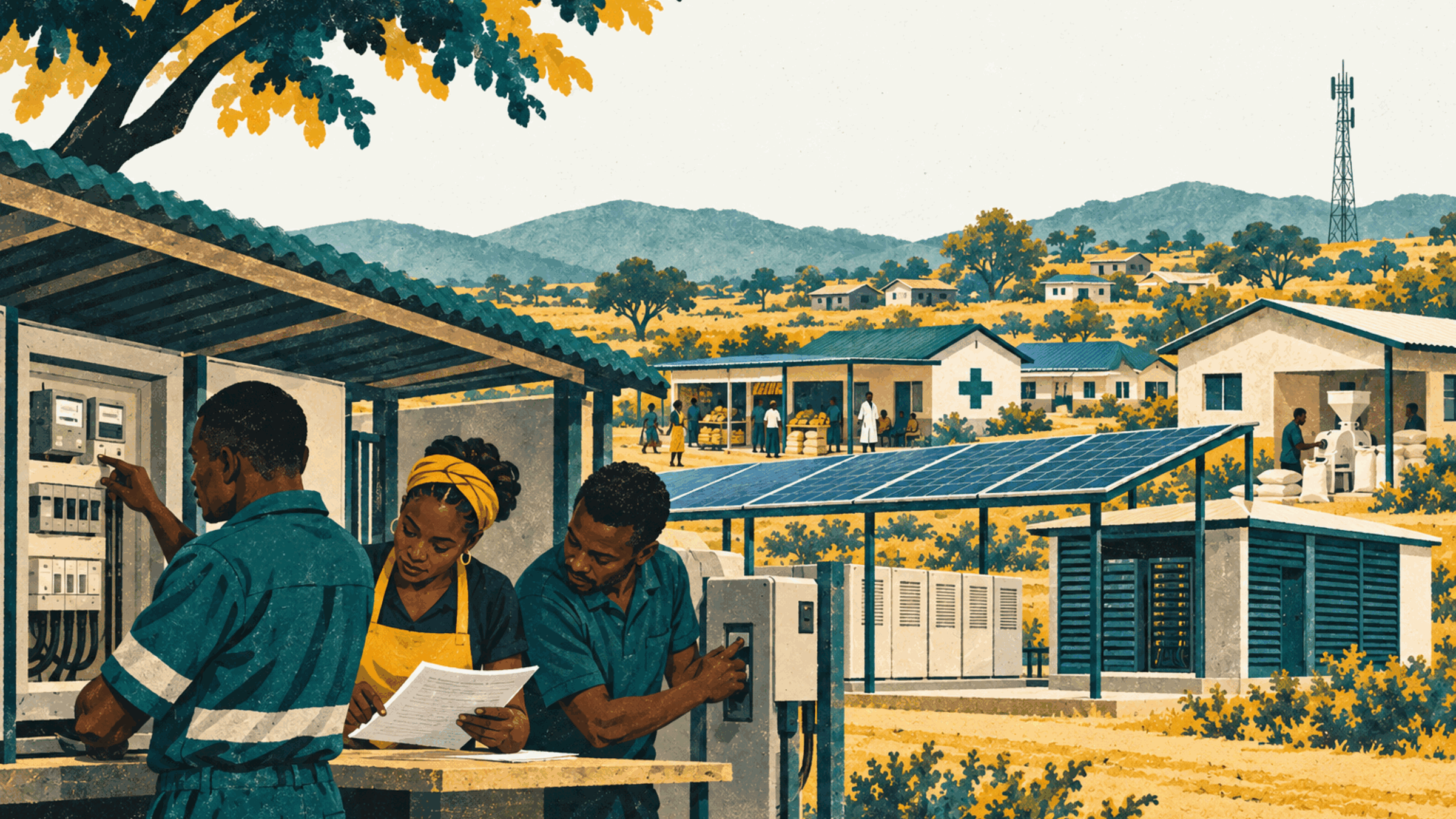
The Emergent Grid Project proposes a bridge between them. The Mission 300 Accelerator will test small computing installations beside renewable mini-grids in Kenya, DRC and Sierra Leone. The computing load would purchase otherwise underused electricity, or justify additional generation that serves both digital workloads and communities. Because some computing tasks can be delayed, shifted or interrupted, community users are intended to retain priority.[1]
The economic logic is credible. Solar mini-grids carry high fixed costs, while household demand can be low and concentrated after sunset. Generation can therefore be underused during daylight hours, especially early in a project's life. World Bank analysis shows that raising a mini-grid's load factor from 22% to 40% can reduce its levelised electricity cost by 27%; agricultural anchor loads exceeding 15% of demand have been estimated to reduce tariffs by 10–15% in a Nigerian pilot analysis.[3][4] A paying customer that consumes power when it is abundant can improve asset utilisation and revenue.
Compute is not automatically that customer. It requires connectivity, power quality, cooling, security, technical support and dependable buyers. Advanced AI equipment can also impose rapid changes in load, while server power density is rising sharply.[2] If the computing service requires uninterrupted electricity, subsidised backup generation, priority access or expensive telecommunications that do not benefit other users, it may add a fragile second infrastructure system rather than strengthen the first.
The decisive design question is therefore not whether Africa should host more computing. It is whether a specific class of flexible digital work can be contracted as a subordinate load: paid, measurable and controllable, but unable to compromise community affordability, reliability or future growth.
STONECOMMS ORIGINAL SYNTHESIS
StoneComms proposes a Community-First Compute Covenant with five tests. Surplus: compute purchases demonstrably underused energy or finances additional capacity. Subordination: automatic controls reduce computing demand before households, enterprises or essential services are constrained. Sharing: a disclosed share of digital revenue lowers tariffs, improves service or finances connections. Local value: the project leaves useful power, connectivity, skills, maintenance capacity and data infrastructure in the host economy. Exit: equipment can scale down, move or change workload as community demand grows, without leaving stranded generation or public liabilities. A pilot that passes the technical test but fails any of the other four has demonstrated co-location, not development value.
WHY THIS MATTERS NOW
A global demand shock is meeting an African utilisation problem
The timing is unusually sharp. The IEA estimates that capital expenditure by the five largest technology companies exceeded US$400 billion in 2025 and could rise by a further 75% in 2026. AI-focused data-centre electricity consumption grew by 50% in 2025, faster than the 17% increase across data centres as a whole.[2] Data-centre developers in several markets are encountering delayed grid connections, equipment constraints and public concern about electricity prices, emissions and water use.
African power systems face a different constraint. Distributed renewable energy is often the least-cost route for remote communities, but many projects need grants, results-based finance or concessional capital because early consumption and revenues are too low to recover fixed costs. The World Bank estimates that 160,000 mini-grids and US$91 billion of cumulative investment would be required for solar mini-grids to serve 380 million people in Africa by 2030. On the trajectory assessed in 2023, only about 12,000 new mini-grids serving 46 million people were expected by that date.[5]
Productive use is central to closing that gap. Milling, refrigeration, irrigation, welding, telecoms and other commercial loads consume more electricity than lighting and phone charging, increase revenue and can build local incomes. World Bank analysis of 1,028 mini-grids in Asia found that each additional percentage point of non-household customers was associated with a 20% increase in average monthly electricity sales until the effect began to taper.[4] African programmes similarly identify agricultural processing and commercial equipment as potential anchor loads.[3]
Compute adds a new possibility: demand that is not limited by the purchasing power or market size of the village around the power system. A remote buyer can purchase a digital service produced beside the mini-grid. If the workload is portable and interruptible, it may consume solar output when local demand is low and withdraw when the community needs power.
That possibility should be tested now, but the global AI boom should not weaken the burden of proof. Rapid investment can make experimental infrastructure appear inevitable before its distributional consequences are understood. The right policy posture is neither rejection nor promotion. It is disciplined demonstration with transparent contracts and independently measured community outcomes.
KEY FINDINGS
Six findings define the investment and governance case
First, the anchor-load mechanism is established, but compute is a new implementation. Mini-grid economics improve when productive loads raise utilisation and revenue. Evidence from agriculture and appliances supports the mechanism; it does not prove that digital workloads will have the same cost, reliability or local-income effects.[3][4]
Second, flexibility is the project's most valuable technical characteristic. A conventional data centre seeks firm power. The proposed model only protects community access if computing jobs can pause or migrate and if control systems enforce that priority automatically. Contractual language without dispatch data is insufficient.[1][2]
Third, additional revenue does not guarantee lower community prices. Revenue can be absorbed by computing equipment, connectivity, cooling, financing costs or operator margins. Tariff and service benefits need an explicit sharing mechanism and a counterfactual showing what would have happened without compute.
Fourth, the three-country portfolio tests materially different propositions. Kenya will test new solar-plus-storage systems at five sites serving communities of approximately 50,000 people. DRC will add compute to an existing underused solar plant serving more than 30,000 people, over 350 small and medium-sized enterprises and 30–40 social institutions. Sierra Leone will add compute at three existing rural sites with spare generation.[1] New-build and retrofit cases should not be pooled into one headline result.
Fifth, connectivity may be as decisive as electricity. Remote computing needs dependable backhaul, cybersecurity, monitoring and maintenance. Africa has expanded international and mobile connectivity, but affordability, rural coverage and local digital infrastructure remain uneven.[6] A viable energy site can still be a poor computing site.
Sixth, local value must extend beyond power sales. Africa attracted only about 3% of global data-centre investment in the period reported by UN Trade and Development, even as data centres became a major global investment category.[7][8] The model will have greater development value if it strengthens local connectivity, technical capability and useful computing access—not only if an overseas customer rents African electrons.
EVIDENCE AND METHOD
This paper tests a proposition, not an announced result
The analysis is a desk-based synthesis of the 24 September 2026 Emergent Grid announcement and public evidence on mini-grid economics, productive electricity use, data-centre energy demand, demand flexibility, African digital infrastructure and sustainable data-centre design.[1–13]
The unit of analysis is a distributed renewable electricity system serving an underserved African community and hosting a separately metered computing load. The paper distinguishes three cases: spare generation at an operating mini-grid; additional generation installed for shared use; and a new power system whose investment case depends partly on compute revenue. These configurations face different additionality, risk and cost-allocation tests.
The evidence base does not yet include site-level capital costs, computing capacity, contracted workloads, tariffs, dispatch rules or baseline load curves for the announced demonstrations. No causal impact claim can therefore be made. The analysis uses established productive-use evidence to identify plausible mechanisms and translates them into questions that the demonstrations should answer.
THE ECONOMIC CASE
Underused generation is a real asset, but only at the right hour
Mini-grid costs are dominated by generation, storage, distribution and operating assets that must be financed before demand is known precisely. Developers need enough capacity to meet evening peaks and future growth. During the day, solar production may exceed household and small-business demand. Low utilisation raises the cost assigned to every kilowatt-hour sold.
Productive customers can improve the shape as well as the volume of demand. World Bank modelling associates an increase in load factor from 22% to 40% with a reduction in levelised electricity cost from about US$0.38 to US$0.28 per kilowatt-hour.[4] In a Nigerian demand-mapping exercise, rice and cassava processing were identified as suitable anchor loads; when agricultural consumption exceeded 15% of total demand, modelled tariff reductions were 10–15%.[3]
These examples do not mean any large customer lowers prices. Timing matters. A load that consumes midday solar can improve utilisation. A load that increases the evening peak may require more batteries, backup generation and distribution capacity. Reliability matters. A customer that pays predictably under a durable contract can support finance; an experimental buyer can add demand without reducing risk. Creditworthiness matters. Revenue denominated in hard currency may strengthen a project, but it can also introduce contractual, tax and foreign-exchange questions.
The demonstration should therefore report hourly or sub-hourly baseline and post-installation load curves, renewable generation, storage state, curtailment, outages and computing dispatch. Annual energy totals will not show whether compute used genuine surplus or competed with local demand.
WHY COMPUTE IS DIFFERENT
Portability can create value, but power quality and connectivity create cost
Digital workloads vary. Some are latency-sensitive and must be processed close to users. Others—batch inference, rendering, model evaluation, data processing or selected training tasks—may tolerate delay and can be scheduled around electricity availability. The Emergent Grid proposition depends on the second category.[1]
This flexibility is commercially significant. An irrigation pump or mill is fixed to a local value chain and may operate only when crops, water or customers are available. Computing equipment can potentially serve a remote market and move work across sites. If a mini-grid has surplus solar power at noon, the operator can increase computing activity; if community demand rises or clouds reduce generation, the computing load can fall.
The claim needs technical qualification. AI servers are becoming more power-dense. The IEA reports that the power density of AI servers increased elevenfold between 2020 and 2025 and could rise another fourfold by 2027. AI workloads can also produce rapid power swings, making storage and power electronics important.[2] A small modular installation is not a hyperscale data centre, but it still requires stable voltage, thermal management, dust protection, physical security and remote maintenance.
Connectivity is another fixed requirement. A site must receive data, software and work instructions and return outputs securely. The ITU's 2025 assessment records continuing gaps in African coverage, affordability and meaningful use despite substantial broadband progress.[6] The cost of dedicated backhaul may erase part of the energy advantage unless the connectivity investment is shared or already available.
The useful design is consequently modest and modular: equipment sized to the verified surplus, capable of remote orchestration, protected against local conditions and contractually required to yield before community loads. The computing service should expand only after measured performance demonstrates that these conditions hold.
A COMMUNITY-FIRST CONTROL ARCHITECTURE
Priority must be engineered, metered and auditable
The Emergent Grid principles state that households, businesses, schools, clinics and essential services will have priority and that computing can be reduced, shifted or relocated as community demand grows.[1] Turning that principle into infrastructure requires more than a policy statement.
The mini-grid controller should enforce a published order of service. Critical public services and agreed household lifeline supply should sit above productive local demand; flexible compute should sit below both. The exact hierarchy will vary by site, but the system must not depend on a remote computing buyer voluntarily yielding during scarcity.
Separate metering should record generation, storage, community sales, technical losses and computing consumption. Service-level measures should include customer outage minutes, voltage quality, effective tariff, new connections, energy served to businesses and essential institutions, compute interruption and the share of potential renewable generation curtailed. The baseline should cover enough seasonal variation to distinguish project effects from rainfall, solar resource, agricultural cycles or network failures.
Cost allocation must be equally visible. If compute requires extra batteries, inverters, backup generation, cooling or connectivity, those costs should not be recovered from community tariffs unless the community receives a transparent, proportionate benefit. Conversely, where compute revenue finances shared assets, the contract should specify who owns them and what happens if the digital customer leaves.
Independent monitoring is therefore not an accessory. The announced evaluation will assess affordability, reliability, project economics, access and socioeconomic outcomes.[1] It should publish definitions, baselines and disaggregated site results wherever commercial confidentiality permits. A portfolio average could conceal a successful DRC retrofit and an uneconomic Kenyan new-build, or vice versa.
THREE COUNTRY TESTS
Kenya, DRC and Sierra Leone should be treated as separate experiments
Kenya: can compute help finance new shared capacity? Five sites are intended to test new solar-plus-storage systems serving communities of approximately 50,000 people.[1] The key counterfactual is whether the systems would have been built, at what size and subsidy, without compute. The evaluation should separate connections and reliability financed by the digital load from benefits already funded by the energy-access programme. Kenya's deeper digital and mobile ecosystem may make connectivity and maintenance easier, but results may not transfer to more fragile markets.
Democratic Republic of Congo: can spare generation become productive revenue? The DRC site already serves more than 30,000 people, over 350 SMEs and 30–40 social institutions.[1] This is the clearest utilisation test because existing generation and customer behaviour can be observed before compute arrives. It is also the clearest crowding-out test: a mature local customer base may grow quickly. Compute should contract as local productive demand expands, unless additional generation is financed.
Sierra Leone: can small rural systems support the digital service stack? Three operating rural sites with underused generation will receive computing equipment.[1] The important questions are operational: backhaul quality, maintenance response, heat and humidity management, spare parts, security and the cost of remote orchestration. A technically successful unit that requires frequent international support may not be scalable.
Cross-country comparison should standardise a small number of measures while preserving context. At minimum: pre- and post-project load factor; renewable curtailment; computing uptime and interruption; customer tariff and connection fee; household and enterprise consumption; service to schools and clinics; operator cash flow; total subsidy per connection; local jobs and maintenance expenditure; connectivity performance; and any water or backup-fuel use.
LOCAL DIGITAL VALUE
Selling compute is not the same as building a digital economy
The project could create three layers of local value. The first is electricity: better utilisation, lower subsidy, stronger operator cash flow and additional connections. The second is shared infrastructure: improved connectivity, storage, power electronics, security and technical maintenance. The third is productive capability: local access to computing, skills, services and enterprise opportunities.
Only the first layer is inherent in the model, and even that must be demonstrated. The other two require deliberate contract design. A computing unit can be remotely owned, remotely managed and dedicated entirely to overseas workloads. It may pay the mini-grid while creating few local jobs beyond security and maintenance. That can still be useful if the energy benefit is large, but it should not be described as digital transformation.
UN Trade and Development reports that data centres accounted for more than one fifth of global greenfield investment in 2025, with announced investment exceeding an estimated US$270 billion. Yet developing economies face strong concentration, and Africa captured only a small share of data-centre investment.[7][8] Investment policy must therefore consider competition, ownership, local suppliers, skills and control of strategic assets alongside headline capital flows.
Small edge installations are not conventional data-centre foreign direct investment. Their advantage is the possibility of diffusion across distributed power sites. Their weakness is limited scale. A credible local-value plan might include shared backhaul capacity, accredited technician training, procurement from local service firms, access to a portion of compute for universities or public-interest applications, and clear rules on data protection and cybersecurity. Each benefit should be costed; none should be assumed.
Environmental design also matters. UNCTAD notes that data-centre expansion is increasing demand for electricity, water and raw materials, while the ITU's green data-centre guidance calls for location-specific assessment of energy and water impacts.[9][10] Air-cooled, modular equipment may be appropriate at small rural sites, but the project should disclose cooling technology, water use, equipment lifespan, replacement cycles and electronic-waste arrangements.
STONECOMMS ORIGINAL SYNTHESIS
The Community-First Compute Covenant turns a pilot into an investable evidence framework
The Covenant is a proposed contract and evaluation architecture derived from the announced project principles, mini-grid productive-use evidence and energy-system guidance.[1–5][9–13]
1. Surplus test. Establish a seasonal baseline of generation, curtailment, storage and customer demand. Size computing capacity to verified surplus or to separately financed additional generation. Report energy use by hour, not only annually.
2. Subordination test. Install automatic dispatch controls. Publish the service-priority hierarchy and record every computing curtailment event alongside community outages. No community interruption should be attributed to energy reserved for compute.
3. Sharing test. Define the community benefit in advance: tariff reduction, additional connections, reliability investment, lifeline energy, public-service supply or a combination. Report the gross computing revenue, computing-specific cost and net contribution to the energy system.
4. Local-value test. Track shared connectivity, local procurement, technician training, maintenance expenditure, local compute access and data governance. Distinguish direct evidence from wider economic expectations.
5. Exit test. Specify who owns generation, storage, networking and computing assets; what happens at contract expiry; whether equipment can be relocated; and how the system responds when local demand absorbs the surplus. Public or concessional finance should not underwrite stranded digital equipment or generation sized for a departed buyer.
These tests create an evidence chain that investors can use. They connect technical performance to revenue, revenue to community benefit, and benefit to an enforceable contract. They also allow a negative result to be useful. If a site fails because backhaul is expensive or surplus is seasonal, that finding can improve site selection rather than being hidden inside a portfolio narrative.
PAN-AFRICAN SCALABILITY TEST
Replication will depend on load, connectivity, regulation and institutional capacity
Africa's mini-grid opportunity is large but heterogeneous. Solar resource, settlement density, productive demand, regulation, licensing, tariffs, subsidy design, mobile connectivity, foreign-exchange access and security vary widely. A model that works in a connected Kenyan market may not work in a remote Sahelian settlement; a DRC site with substantial SMEs may not represent a newly electrified village.
Four screens should precede expansion.
Energy screen: Is there measured renewable surplus, persistent curtailment or a viable plan for additional shared generation? What is the seasonal and hourly profile?
Digital screen: Is resilient backhaul available at a cost the computing service can bear? Can the workload tolerate latency and interruption? Are cybersecurity, data protection and lawful data transfer arrangements clear?
Commercial screen: Is there a creditworthy buyer, a transparent price for compute and a contract long enough to support investment? Who bears hardware obsolescence and foreign-exchange risk?
Public-value screen: Is the community benefit additional, measurable and protected? Can the regulator enforce priority and tariff arrangements? Is there local capacity to maintain both systems?
The best first sites may be neither the most remote nor the least electrified. They are likely to have renewable surplus, credible operators, sufficient connectivity, measurable unmet demand and institutions capable of protecting community priority. That is a demonstration portfolio, not a claim that compute is the universal anchor load for African electrification.
IMPLICATIONS FOR POLICY, CAPITAL AND IMPLEMENTATION
Treat compute as contracted flexibility, not privileged demand
For governments and regulators, the project requires rules for co-located generation, tariffs, metering, priority service, data protection, electronic waste and the arrival of the main grid. Regulators should prevent computing costs from migrating into community tariffs and should preserve the right of local demand to grow.
For development-finance and philanthropic institutions, concessional support should buy evidence and public value. Funding can cover first-of-a-kind control systems, independent evaluation and shared infrastructure, but it should decline as the model proves commercial. Subsidy per new or improved connection should be compared with conventional mini-grid and productive-use alternatives.
For mini-grid developers, the opportunity is a more predictable daytime customer. The operational burden includes power quality, scheduling, connectivity coordination and a second technology stack. Developers should not assume that computing revenue compensates for weak community engagement or low productive use.
For computing buyers and technology firms, flexibility must be real and externally verifiable. Workloads should tolerate interruption, equipment should suit local conditions and commercial agreements should disclose the energy-system benefit. Purchasing power beside a mini-grid is not, by itself, a social-impact claim.
For communities and local enterprises, participation should begin before equipment placement. Customer priorities, service problems, tariff expectations and future productive demand should shape system sizing and dispatch. Complaints and outage reporting need accessible routes that do not depend on the computing operator.
RISKS, COUNTERARGUMENTS AND LIMITATIONS
The strongest objections should define the evaluation
The first objection is that the model could distract from local productive demand. A mill, cold store or irrigation system creates visible local output and employment; remote compute may not. The response is not to treat compute as superior, but to compare it with the best feasible local anchor load at each site. Where productive enterprises can absorb surplus economically, appliance finance and market development may create more direct value.[3][4]
The second objection is crowding out. Even a flexible load can influence system sizing, storage and operator behaviour. A high-paying computing buyer may receive informal priority. Automatic controls, separate metering and independent outage data are necessary to test the promise of subordination.
The third is commercial volatility. Computing demand, hardware values and AI economics are changing quickly. A buyer may withdraw, equipment may become obsolete or export controls may restrict replacement. The electricity asset must remain viable under a downside case in which compute revenue falls materially or ends.
The fourth is environmental burden. Computing equipment embodies minerals and manufacturing emissions and creates heat and electronic waste. Cooling can use water. The appropriate comparison is lifecycle impact per unit of useful service, with disclosure of equipment, cooling, backup fuel, water, refurbishment and end-of-life routes.[9][10]
The fifth is digital extraction. African electricity and infrastructure could serve external workloads while ownership, data, intellectual property and high-value employment remain elsewhere. Contracted local benefits and shared infrastructure can reduce this risk, but small rural installations will not by themselves create an AI industry.
This paper is limited by the early stage of the demonstration. Site operators, computing customers, technical configurations, capital costs, tariffs and contracts were not public in the reviewed announcement. Estimates from global data centres should not be applied mechanically to modular edge equipment. Mini-grid evidence from other productive loads establishes mechanisms, not expected project outcomes.
COMMISSIONABLE RESEARCH AGENDA
The next study should follow electricity, money and control at site level
A serious evaluation programme could be commissioned around five workstreams.
- Technical baseline and dispatch study: twelve months of generation, storage, curtailment, demand, power quality, connectivity and outage data at pilot and comparison sites.
- Financial additionality analysis: complete capital and operating cost, subsidy, revenue, tariff and cash-flow models with and without compute, including foreign-exchange and hardware-obsolescence scenarios.
- Community outcomes study: household, enterprise and public-service surveys; effective electricity price; connection growth; reliability; productive use; distributional impacts by gender, income and livelihood; and qualitative evidence on service experience.
- Digital local-value assessment: backhaul, local procurement, employment, technician capability, compute access, data governance, cybersecurity and electronic-waste pathways.
- Replication and regulation study: comparable screening of candidate markets and a model Community-First Compute Covenant for licensing, tariffs, service priority, disclosure, ownership and exit.
The evaluation should publish site-level findings and retain unsuccessful sites in the evidence base. The most valuable output may be a clear account of where the model does not work.
CONCLUSION
The experiment deserves attention because its claim can be falsified
The Emergent Grid idea begins with a practical observation: renewable mini-grids may have electricity they cannot yet sell, while digital markets are searching for power. Flexible compute could connect those conditions and create revenue that improves electricity access.
That bridge will only carry public value if compute behaves differently from the large, inflexible data-centre loads now straining power systems elsewhere. It must buy true surplus, yield automatically to local need, finance an explicit community benefit, contribute useful local infrastructure and be able to withdraw without leaving liabilities.
The initial sites in Kenya, DRC and Sierra Leone create a rare opportunity to test those conditions across new-build and operating systems. If the project publishes transparent technical, financial and community evidence, a positive result could open a new form of distributed-infrastructure finance. A negative or mixed result would be equally useful if it identifies the limits.
The important outcome is not a story about AI arriving in a village. It is a contract in which a global digital customer becomes accountable to the local electricity system that makes its work possible.
Methodology
METHODOLOGY
This report uses structured desk research completed on 28 September 2026. It reviews the public announcement of the Emergent Grid demonstrations and triangulates the proposed mechanism with World Bank and ESMAP evidence on mini-grids and productive electricity use; IEA evidence on AI, data-centre demand and electricity-system flexibility; ITU evidence on African digital connectivity and green data-centre requirements; and UN Trade and Development evidence on digital investment and environmental impacts.[1–13]
The analysis is qualitative and mechanism-based. Quantitative figures are reproduced from issuing institutions and are not combined into a project forecast. The StoneComms original synthesis translates the evidence into a five-test contract and evaluation framework. It does not represent original fieldwork, access to project contracts or proprietary operational data.
Limitations
RISKS, COUNTERARGUMENTS AND LIMITATIONS
The strongest objections should define the evaluation
The first objection is that the model could distract from local productive demand. A mill, cold store or irrigation system creates visible local output and employment; remote compute may not. The response is not to treat compute as superior, but to compare it with the best feasible local anchor load at each site. Where productive enterprises can absorb surplus economically, appliance finance and market development may create more direct value.[3][4]
The second objection is crowding out. Even a flexible load can influence system sizing, storage and operator behaviour. A high-paying computing buyer may receive informal priority. Automatic controls, separate metering and independent outage data are necessary to test the promise of subordination.
The third is commercial volatility. Computing demand, hardware values and AI economics are changing quickly. A buyer may withdraw, equipment may become obsolete or export controls may restrict replacement. The electricity asset must remain viable under a downside case in which compute revenue falls materially or ends.
The fourth is environmental burden. Computing equipment embodies minerals and manufacturing emissions and creates heat and electronic waste. Cooling can use water. The appropriate comparison is lifecycle impact per unit of useful service, with disclosure of equipment, cooling, backup fuel, water, refurbishment and end-of-life routes.[9][10]
The fifth is digital extraction. African electricity and infrastructure could serve external workloads while ownership, data, intellectual property and high-value employment remain elsewhere. Contracted local benefits and shared infrastructure can reduce this risk, but small rural installations will not by themselves create an AI industry.
This paper is limited by the early stage of the demonstration. Site operators, computing customers, technical configurations, capital costs, tariffs and contracts were not public in the reviewed announcement. Estimates from global data centres should not be applied mechanically to modular edge equipment. Mini-grid evidence from other productive loads establishes mechanisms, not expected project outcomes.
Sources
<p>The announcement is the only source for the configuration and projected reach of the Emergent Grid demonstrations. Those figures describe intended sites and projections, not verified outcomes. Mini-grid cost and load-factor evidence comes from broader studies and examples with different technologies and markets. Global data-centre figures describe a much larger industry than the proposed modular installations and are used to establish context, not to estimate site demand. All causal and scalability claims remain hypotheses for independent evaluation.</p>
SOURCES
- The Rockefeller Foundation and Mission 300 Accelerator. “The Rockefeller Foundation and Mission 300 Accelerator Launch Demonstration to Test Whether AI Demand Can Help Finance Energy Access in Africa.” 24 September 2026. https://www.rockefellerfoundation.org/news/rockefeller-foundation-mission-300-launch-test-ai-demand-finance-energy-access-africa/
- International Energy Agency. Key Questions on Energy and AI. 16 April 2026. https://www.iea.org/reports/key-questions-on-energy-and-ai
- Energy Sector Management Assistance Program, World Bank. Accelerating the Productive Use of Electricity: Enabling Energy Access to Power Rural Economic Growth. 2023. https://documents1.worldbank.org/curated/en/099092023192023389/pdf/P175152-d3f58f6f-307c-4996-9e14-b8baef6de8dd.pdf
- Energy Sector Management Assistance Program, World Bank. Mini Grids for Half a Billion People: Market Outlook and Handbook for Decision Makers. 2022 edition. https://documents1.worldbank.org/curated/en/099635009232259510/pdf/P1751510dd4ab407e083a6098d1905fa94f.pdf
- World Bank. “Solar Mini Grids Could Sustainably Power 380 Million People in Africa by 2030—If Action Is Taken Now.” 27 February 2023. https://www.worldbank.org/en/news/press-release/2023/02/26/solar-mini-grids-could-sustainably-power-380-million-people-in-afe-africa-by-2030-if-action-is-taken-now
- International Telecommunication Union. State of Digital Development and Trends in the Africa Region: Challenges and Opportunities. 2025. https://www.itu.int/pub/D-IND-SDDT_AFR-2025
- UN Trade and Development. “Global Investment in the Digital Economy Surges but Remains Uneven.” 2025. https://unctad.org/news/global-investment-digital-economy-surges-remains-uneven
- UN Trade and Development. “Data Centres Are Reshaping the Global Investment Landscape.” 2026. https://unctad.org/news/data-centres-are-reshaping-global-investment-landscape
- UN Trade and Development. Digital Economy Report 2024: Shaping an Environmentally Sustainable and Inclusive Digital Future. 2024. https://unctad.org/publication/digital-economy-report-2024
- International Telecommunication Union and World Bank. Green Data Centers: Towards a Sustainable Digital Transformation—A Practitioner's Guide. 2023. https://www.itu.int/en/ITU-D/Environment/Pages/Toolbox/Green-data-center-guide.aspx
- International Energy Agency. The Value of Demand Flexibility. 2025. https://www.iea.org/reports/the-value-of-demand-flexibility
- International Finance Corporation. “Scaling Mini-Grid Program.” Accessed 28 September 2026. https://www.ifc.org/en/what-we-do/sector-expertise/infrastructure/energy/scaling-mini-grid
- World Bank Group. “Mission 300: Frequently Asked Questions.” Accessed 28 September 2026. https://www.worldbank.org/ext/en/energizingafrica/faq