Key metrics
- 15-20% - Africa's total trade estimated to be intra-African, World Bank 2026. [1]
- ~60% - share of trade costs estimated to arise behind countries' own borders, World Bank 2026. [1]
- 28 countries / 190+ banks and fintechs - PAPSS-reported network reach after BEAC joined in July 2026. [8]
- $265 million - AfDB/partner first-phase loan and grant approved for Zambia's Lobito participation in August 2026. [10]
EXECUTIVE THESIS
The next African border is inside the production system
Africa's formal integration architecture has moved faster than the operating systems that firms need to use it. The African Continental Free Trade Area has created the framework for a continental market, but a tariff preference does not move a truck, settle an invoice, certify a component, keep a production line powered or make two customs systems exchange data.
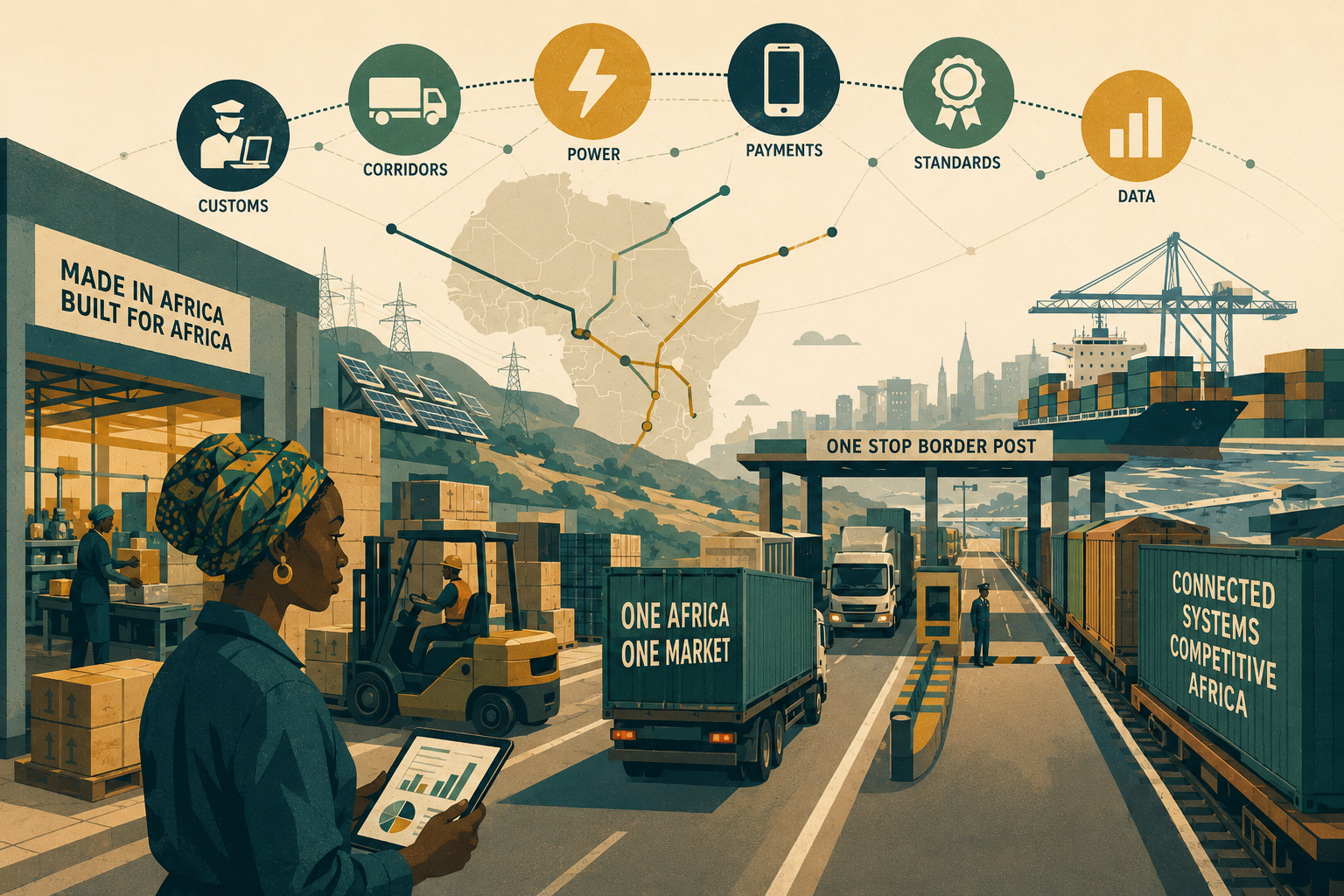
That distinction moved sharply into view on 28 August 2026, when the World Bank, African Union and UNECA launched Integrating Africa: From Threads to Hubs. The report argues that Africa's integration challenge has shifted from creating market access to making markets work together. It estimates that only 15-20 per cent of Africa's total trade is intra-African, while about 60 per cent of trade costs arise behind countries' own borders. It identifies customs, transport, standards, payments, services, energy, finance, digital platforms and data as the systems whose fragmentation can keep neighbouring markets economically distant even after tariffs fall. [1][2][3]
The report is timely because large pieces of the required infrastructure are moving from policy to implementation. East Africa is trying to take one-stop borders beyond physical co-location into technology-driven management. West Africa has synchronized interconnected power systems and is moving toward a day-ahead electricity market. PAPSS is extending local-currency payment connectivity across regions. Zambia, Angola and the Democratic Republic of Congo have explicitly agreed that the Lobito Corridor cannot succeed as infrastructure alone. The Abidjan-Lagos highway is being structured as a supranational asset under a dedicated corridor authority rather than five disconnected national road projects. [4][7][8][10][11][12][13]
These are often discussed as separate achievements. StoneComms' central finding is that their value is multiplicative, not additive.
STONECOMMS ORIGINAL SYNTHESIS
A regional production hub is not created by a road, a trade agreement, a power line or a payment switch in isolation. It emerges when those systems can be used together with predictable rules. Africa's next integration challenge is therefore best understood as a Production Operating System problem: the interfaces between movement, power, payment, proof and governance must work well enough for a firm to distribute production across borders without rebuilding its operating model at each frontier.
The investment implication is equally important. Development finance and public capital should increasingly measure whether a corridor is integration-complete, not merely asset-complete. A railway can reach commissioning while the economic corridor remains unfinished. A highway can open while customs, standards, power access and payments still behave as national islands.
The practical policy goal is not uniformity. It is minimum viable interoperability: agree the interfaces that must work across borders, while allowing countries and firms to retain different institutions, technologies and commercial models underneath them.
KEY FINDINGS
01 MARKET ACCESS IS NO LONGER THE WHOLE BOTTLENECK
The new World Bank integration agenda is explicit: formal commitments matter, but the next gains depend on systems firms use every day. With an estimated 60 per cent of trade costs arising behind national borders, a large part of the integration agenda is now administrative, regulatory and infrastructural rather than diplomatic. [1]
02 EAST AFRICA SHOWS THAT SOFT INFRASTRUCTURE CAN CHANGE HARD ECONOMICS
The EAC reports that its Single Customs Territory and one-stop border architecture have materially reduced transit times and costs, but its July 2026 border missions also found that the next gains require smarter, technology-driven management and removal of domestic administrative bottlenecks. Progress creates a new frontier rather than ending the reform process. [4][5][6]
03 POWER AND PAYMENTS ARE CORRIDOR INFRASTRUCTURE TOO
West Africa's synchronized regional power system and planned day-ahead market show that energy can be traded as a regional public good. PAPSS is building an analogous financial layer, reporting connectivity across 28 African countries and more than 190 commercial banks and fintechs after BEAC joined in July 2026. These systems can reduce production friction even when no new road is built. [7][8]
04 LOBITO HAS STARTED TO ASK THE RIGHT SECOND QUESTION
The first question was how to connect the Copperbelt to the Atlantic. The emerging second question is what economic system should grow around that connection. In February 2026 the three corridor governments formally recognised that infrastructure alone is insufficient and agreed on a joint investment platform linking logistics to industrial yards, production zones, processing hubs, agribusiness, energy, urban development and SMEs. [11]
05 ABIDJAN-LAGOS IS AN INSTITUTIONAL EXPERIMENT AS MUCH AS A ROAD PROJECT
The five-country corridor is being designed as a single unified asset under a supranational management authority. That creates a rare chance to make governance, trade facilitation and spatial development part of the infrastructure design rather than retrofits after construction. [12][13]
06 THE NEXT DFI PRODUCT SHOULD FINANCE INTERFACES
The missing instrument is an Integration Covenant: measurable conditions attached to regional infrastructure finance that require compatible border data, corridor performance standards, power-market access, payment interoperability, standards recognition and credible joint governance where relevant. It would not prescribe one technology. It would make the economic interfaces bankable.
1 WHY THIS MATTERS NOW
Africa has more integration hardware - and a clearer view of the software gap
For two decades, much of the regional integration story has been told through visible assets and formal milestones: roads, bridges, ports, customs unions, free-trade protocols and interconnectors. Those assets remain essential. But their economic value depends increasingly on less visible systems.
A manufacturer deciding whether to split production across two or three African markets does not experience "integration" as a treaty. It experiences a sequence of operational questions. Can inputs cross the border on a predictable timetable? Will the same certification be accepted? Can the firm buy power competitively? Can suppliers be paid in local currency without a long correspondent-banking chain? Can a professional or technician work across the border? Are tax, customs and product rules legible enough to price a contract? If a disruption occurs, is there an institution capable of resolving it?
The World Bank's new report frames this as economic distance. That is a useful idea because geography is fixed but economic distance is designed. Two cities can be 300 kilometres apart and still behave like distant markets if a truck is repeatedly inspected, a payment requires an external currency, a component needs recertification, a power system cannot trade across the border and a dispute has no credible route to resolution. [1][3]
The reverse is also true. A well-governed corridor can make a larger geography function like a smaller market.
This matters for industrial policy. Intra-African trade is a relatively small share of the continent's total trade, but the World Bank finds it is more diversified and manufacturing-intensive than Africa's external trade. Regional markets therefore offer something that export corridors alone do not: a space for firms to learn, specialise, source across borders and reach scale before or while competing globally. [1]
The critical shift is from moving goods to organising production.
2 THE EAST AFRICAN LESSON
A border post works best when it stops behaving like a border post
East Africa provides one of the continent's clearest examples of integration moving from physical infrastructure into operating systems.
The EAC launched its Single Customs Territory in 2014. Its model allows customs assessment and duty payment for destination countries to begin at the first point of entry, supported by interconnected customs systems and common procedures. The EAC reports that the Single Customs Territory reduced the cost of doing business by 70 per cent and cut truck turnaround from 21 days to less than four days on selected routes. It also reports 16 fully operational one-stop border posts and reductions in transit time of up to 72 per cent. These are institutional performance claims and should not be treated as an independently audited regional time series, but they are consistent with the direction of reform: replace repeated national procedures with a shared process. [5]
That reform is now reaching its own limit. In July 2026 the EAC carried out monitoring missions at Horohoro/Lungalunga, Namanga/Namanga, Sirari/Isebania and Busia/Busia. Its conclusion was not that the one-stop model had failed. It was that co-location was no longer enough. The Community called for smarter, technology-driven border management and for partner states to remove domestic administrative bottlenecks that still delay goods and raise costs. [4][6]
This is a valuable pattern for the rest of the continent: each successful layer exposes the next constraint.
Building a shared border post can remove duplicate physical stops. Interconnecting customs systems can remove duplicate data entry. Risk-based inspection can reduce the share of consignments physically checked. Mutual recognition can remove duplicate certification. A regional payment system can remove an external settlement step. None of these reforms substitutes for the others.
STONECOMMS ANALYSIS
The EAC example suggests that regional integration should be managed as a continuous friction budget rather than a one-off compliance exercise. Once one source of delay is reduced, corridor institutions should measure where the remaining time, uncertainty and cost have migrated. The KPI should not be "border post completed". It should be "economic distance reduced".
That requires data capable of following a shipment, payment or service transaction across the whole journey rather than reporting one agency's processing time in isolation.
3 POWER IS PART OF THE FACTORY FLOOR
A regional market cannot become a production system if electricity stops at the border
Manufacturing integration is often discussed as a logistics problem, but reliable power is part of the same production geography.
West Africa offers a live example of the regional-public-good model. The World Bank reported in May 2026 that the West African Power Pool and the ECOWAS Regional Electricity Regulatory Authority were operating interconnected grids in synchronisation and preparing a short-term day-ahead electricity market. The programme allows utilities to buy power across borders, with regulators validating day-ahead tariffs in late 2025. The World Bank reports that cross-border hydropower imports materially reduced generation costs for utilities in The Gambia and Guinea-Bissau and lowered costs in Liberia and Sierra Leone. [7]
Again, these results are programme-reported rather than a substitute for firm-level industrial power data. But the institutional point is strong. A power pool changes the meaning of a border for a factory. If electricity can be traded regionally under predictable settlement and regulatory rules, national generation constraints need not map directly onto industrial geography.
That creates a deeper question for corridor planning. Transport infrastructure decides where inputs and outputs can move. Power markets influence where transformation can occur. A mineral corridor designed only around evacuation to a port may reinforce extraction geography. A corridor designed alongside regional energy access can widen the set of viable locations for processing, fabrication and supplier industries.
STONECOMMS ORIGINAL SYNTHESIS
Corridor appraisal should therefore include a production-energy test: not simply whether power exists along the route, but whether industrial users can access sufficiently reliable and competitively priced electricity at the nodes where value addition is expected to happen.
A road to an industrial zone without an energy pathway is not an integrated industrial investment. It is a transport asset adjacent to an aspiration.
4 PAYMENTS ARE LOGISTICS FOR MONEY
The goods can cross faster than the invoice
Physical trade and financial settlement are often measured separately, even though firms experience them as one transaction.
PAPSS is an attempt to build a continental payment layer that lets cross-border transactions settle in African currencies rather than routing every payment through external correspondent systems and third-party currencies. In July 2026 PAPSS reported that BEAC had joined the network, bringing its reach to 28 African countries, more than 190 commercial banks and fintechs and 16 switches, with extended partners connecting more institutions. BEAC serves the six CEMAC countries, giving the platform a new route into Central Africa. [8]
Earlier in 2026, PAPSS and Kenya's Pesalink announced a connection that links more than 80 Kenyan participants to more than 160 PAPSS banks and fintechs for 24/7 cross-border local-currency payments. Those figures are PAPSS-reported network coverage, not evidence that every participant is generating material transaction volume. Adoption, pricing, liquidity and user experience still need to be tested empirically. [9]
The significance is architectural. A payment layer can overlay several physical trade corridors at once. It can reduce one type of economic distance without waiting for the completion of a highway or railway.
For SMEs, that can be as important as freight speed. A business that receives goods in four days but waits for settlement, carries foreign-exchange risk or pays several intermediaries still experiences a fragmented market.
The same logic applies to trade finance. Interoperable payments do not solve working-capital constraints, credit risk or documentary complexity by themselves, but they can make those problems more visible and measurable. Once settlement is faster and standardised, financing products can be designed around a clearer transaction trail.
5 LOBITO: FROM EVACUATION ROUTE TO ECONOMIC CORRIDOR
The governments have explicitly recognised that the railway is not enough
The Lobito Corridor is strategically important because it joins two competing narratives about African infrastructure.
The first is global: faster access from the mineral-rich Copperbelt to the Atlantic, at a time when copper and other critical minerals matter to energy transition and industrial supply chains. The second is regional: whether that transport investment can support value addition, agriculture, energy, SMEs and urban growth across Angola, the Democratic Republic of Congo and Zambia.
The second narrative is no longer only rhetorical. In February 2026, after a high-level coordination meeting in Luanda, the three governments agreed to develop a shared corridor master plan, define a harmonised concept of an "economic corridor", establish a joint investment platform and advance trade facilitation and border reforms. Zambia's Ministry of Finance stated explicitly that infrastructure alone is not sufficient and described links from transport and logistics to industrial yards, production zones, processing hubs, agribusiness, energy, urban development and SMEs. [11]
Six months later, the African Development Bank approved a $255 million African Development Fund loan and a $10 million grant for Zambia's participation in the corridor. The Bank describes the first phase as an integrated approach connecting transport infrastructure with trade facilitation, agriculture, energy, urban development and institutional capacity. It says further resource mobilisation could reach up to $500 million in subsequent phases. The project includes a planned 550 kilometres of railway in Zambia, 105 kilometres of road upgrades and trade-facilitation measures. [10]
Those figures are commitments and plans, not completed outcomes. The economic transformation case remains a hypothesis to be tested against procurement, construction, border performance, investment decisions and actual firm location.
But the structure is important. The corridor is beginning to treat industrialisation as an operating model rather than an assumed spillover from railway construction.
STONECOMMS ORIGINAL SYNTHESIS
Lobito should be judged by a value-capture gradient, not by tonnage alone. The key question is whether a larger share of economic activity accumulates around corridor nodes as goods move toward the port: processing, maintenance, warehousing, professional services, supplier manufacturing, energy services, food systems and local logistics.
If the corridor mainly reduces the cost of exporting unprocessed material, it may be commercially successful infrastructure without becoming a regional production hub. If it also makes intermediate processing and supplier industries more viable across the three countries, it becomes a different economic object.
That distinction should be visible in the project's KPIs.
6 ABIDJAN-LAGOS: BUILDING GOVERNANCE BEFORE ASPHALT
A 1,000-kilometre road is also a test of supranational delivery
The Abidjan-Lagos corridor provides a different experiment. Its challenge is not to retrofit integrated governance around an existing railway. It is to build a major road asset and its operating institution together.
In April 2026 the African Development Bank said the 1,028-kilometre highway had entered its investment phase after feasibility work, with the five participating countries agreeing under a Corridor Treaty that it would be built and operated as a single unified asset. A supranational Abidjan-Lagos Corridor Management Authority, ALCoMA, has been established to oversee design, construction and operation. The Bank had already provided $25 million in technical assistance. [12]
By June, ALCoMA's board had held its first meeting. The Bank described the wider corridor as integrating trade and transport facilitation, value-chain development and logistics components, while financing partners worked on a coordinated investment mechanism. [13]
The exact road length appears differently in current AfDB communications - 1,028 kilometres in April and 1,081 kilometres in June. StoneComms therefore uses the earlier 1,028-kilometre figure only when referring to the April financing mission and does not treat the discrepancy as material to the policy analysis. It should be reconciled before engineering or financial modelling. [12][13]
The institutional design is more interesting than the kilometre count. Five national roads joined at borders would still be five national systems. A corridor treaty and supranational authority create the possibility of common performance standards, coordinated maintenance, shared revenue logic, interoperable tolling, aligned border procedures and spatial-development planning.
Whether those possibilities are realised will depend on implementation. But the governance architecture gives the project a better chance of behaving as one economic corridor rather than a chain of construction contracts.
7 STONECOMMS ORIGINAL SYNTHESIS
The Production Operating System
The evidence across these cases points to a practical framework for deciding whether regional integration is ready to support distributed production.
A corridor or regional market needs five interfaces to work together.
1 MOVE - goods and people cross predictably
This is the visible layer: roads, rail, ports and border posts. But the relevant measure is reliability, not distance built. A manufacturer values the distribution of border and transit times - including the bad days - because inventory and working capital are priced around uncertainty.
Minimum interface: shared corridor KPIs, interoperable customs data, risk-based inspections, predictable transit rules and a mechanism to identify bottlenecks across the whole route.
2 POWER - energy can follow production
A regional production network requires power that is reliable enough for industrial scheduling and priced competitively enough for transformation. Regional power pools can widen the geography of supply, but the industrial nodes along corridors need physical connection, commercial access and bankable payment arrangements.
Minimum interface: transparent connection rules, cross-border market access where feasible, credible settlement and a corridor-level view of future industrial load.
3 PAY - money settles at the speed of commerce
Firms need cross-border payments that do not turn a regional sale into a foreign-exchange and correspondent-banking project. PAPSS and connected national switches show one route toward an interoperable layer, but coverage should be measured by usable transaction pathways, not membership alone.
Minimum interface: accessible local-currency settlement, transparent fees, compatible identity and compliance processes and links to trade-finance products.
4 PROVE - a product or professional does not become unknown at every border
Standards, certification, licensing and professional recognition are quieter forms of infrastructure. Duplicate testing or certification can erase the advantage created by a faster road. The World Bank's integration agenda places mutual recognition and common standards alongside transport and payments for exactly this reason. [1]
Minimum interface: mutual-recognition arrangements where risk allows, shared or trusted conformity-assessment infrastructure and transparent rules for services and professional mobility.
5 GOVERN - someone owns the system between the assets
The hardest failures sit between mandates. A customs agency can improve customs; a utility can improve power; a transport ministry can build a road. Regional production needs an institution able to see the whole transaction and resolve cross-border failures that no single national agency owns.
Minimum interface: a corridor or REC-level delivery body with measurable obligations, escalation routes, shared data and enough authority to convene national agencies and private operators.
The analytical bridge
The framework does not claim that these five layers have equal economic weight in every corridor. A food corridor, a mineral corridor and a services corridor will have different bottlenecks. Nor does it imply that each layer requires a new institution.
The proposition is narrower: the expected value of a regional production investment is constrained by its weakest essential interface. If a firm can move goods but cannot power a plant, certify output or settle transactions predictably, the corridor is connected but not production-ready.
This is a hypothesis suitable for testing with firm-level data. It is not yet a measured continental index.
8 A PAN-AFRICAN SCALABILITY TEST
Do not standardise the institutions; standardise the questions
The temptation with a continental market is to seek one continental solution. The evidence suggests a better division of labour.
The World Bank report uses the principle of subsidiarity: reforms should sit at the institutional level capable of delivering them. Many customs, logistics and inspection reforms are national. Corridors, mutual recognition and power markets often require regional coordination. Continental institutions can provide common frameworks for standards, competition, services, investment and non-tariff measures. [1]
The Production Operating System should work in the same way.
East Africa does not need to copy West Africa's power-market institutions. Lobito does not need the same governance model as Abidjan-Lagos. A landlocked mineral corridor should not be scored against the exact needs of a coastal food value chain.
What can be common is the diagnostic:
- Where does a cross-border production transaction still stop and restart?
- Which friction is national, which is bilateral, which is regional and which needs continental coherence?
- What data would prove that the reform changed firm behaviour rather than merely institutional process?
- Which interface is likely to become the next constraint if today's bottleneck is removed?
That makes the framework compatible with institutional diversity rather than hostile to it.
9 IMPLICATIONS FOR POLICY, CAPITAL AND IMPLEMENTATION
Finance the joins
The infrastructure pipeline across Africa is full of projects that are individually rational. The harder investment question is whether the joins between them are financed and governed.
1. Add an Integration Covenant to regional infrastructure finance
DFIs and public lenders can require regional projects to specify the interfaces that must work at commissioning. The covenant would be tailored to the asset and corridor, but could include common border KPIs, customs data exchange, non-discriminatory infrastructure access, payment interoperability, standards recognition, corridor governance and publication of performance data.
The purpose is not conditionality for its own sake. It is to protect the economic case for the capital asset.
2. Treat soft infrastructure as CAPEX-enabling infrastructure
Customs interoperability, regulatory alignment and corridor data systems are often described as technical assistance beside the "real" project. That framing can underfund the components that determine whether the physical asset is used efficiently.
Where a digital customs interface or standards-recognition programme materially changes asset utilisation, it belongs in the investment logic, even if it does not appear as concrete or steel.
3. Build corridor dashboards around variance, not averages
Average crossing time is useful but insufficient. Manufacturers and logistics firms price uncertainty. A corridor can have a good average and still be commercially difficult if bad-day performance is extreme.
Performance frameworks should track median and tail crossing times, inspection frequency, document errors, payment settlement time, power interruptions, standards-processing time and the resolution of reported non-tariff barriers.
4. Link industrial zones to regional systems before marketing them
Industrial parks are often promoted through land, tax incentives and proximity to transport. The production-system test adds power-market access, border reliability, cross-border payments, standards infrastructure and labour/services mobility.
A zone marketed as regional should be able to demonstrate those interfaces, not merely its distance from a highway.
5. Measure local value capture without turning corridors inward
Regional value addition should not become a justification for inefficient localisation. The World Bank report is clear that regional and global integration can reinforce each other. [1]
The objective is to create capabilities that make African firms more competitive in both markets. Corridor policy should therefore measure supplier development, processing and services growth alongside export performance, without assuming every stage of every value chain must be local.
10 RISKS, COUNTERARGUMENTS AND LIMITATIONS
Interoperability can become bureaucracy if every interface becomes a committee
The strongest counterargument is practical. Regional projects are already difficult to coordinate. Adding payment, power, standards and data obligations could slow investment, create overlapping mandates and encourage institutions to design perfect systems before firms have demand for them.
That risk is real.
The response is minimum viable interoperability. Start with interfaces where fragmentation imposes a demonstrated cost and where coordination can plausibly change firm behaviour. Do not create a regional institution when an API, mutual-recognition agreement, common KPI or bilateral operating protocol will do.
A second counterargument is that large anchor investors can internalise many frictions. A mining company may build dedicated power, logistics and payment arrangements rather than wait for regional systems. This can accelerate projects. But it can also create islands of high-quality infrastructure that smaller suppliers cannot use. The policy question is where private integration can be opened to wider economic use without undermining the anchor investment.
A third is that the regional-production thesis can overstate proximity. Some African value chains will remain globally oriented because inputs, technology, capital equipment or customers sit outside the continent. The evidence does not support regionalisation as an alternative to global integration. The stronger argument is that better regional systems can help firms accumulate capability and scale while remaining connected to global markets. [1]
The largest evidence gap is firm behaviour. Public institutions can report border-time reductions, network membership and infrastructure completion. Those measures do not automatically tell us whether firms changed sourcing, investment or production location. The next stage of research must connect system performance to company decisions.
11 COMMISSIONABLE RESEARCH AGENDA
Build a Regional Production Readiness Index from transactions, not declarations
The desk evidence is strong enough to define the question but not to measure the economic value of each interface. A commissionable next study should create a comparable dataset across three to five African corridors.
A credible design would combine:
Firm survey and interviews: manufacturers, processors, logistics firms, SMEs and anchor investors asked where cross-border transactions fail, what inventory buffers they hold and which frictions change location decisions.
Shipment-level corridor data: border timestamps, inspection rates, transit variance, document errors, customs release and non-tariff-barrier resolution.
Energy data: industrial tariffs, outage frequency and duration, connection lead times, cross-border power availability and settlement performance.
Payment data: transaction time, fees, currency conversion, rejection rates, working-capital effects and adoption of local-currency pathways.
Standards and services data: test and certification time, mutual-recognition coverage, professional licensing and repeat compliance costs.
Investment outcomes: industrial-zone occupancy, supplier formation, local processing, cross-border sourcing and changes in firm productivity where data permit.
The output should not be a league table for publicity. It should identify each corridor's binding constraint, estimate the value of removing it and create an investment sequence.
A 20-week programme could begin with protocol and data-sharing design, move through corridor fieldwork and firm interviews, then combine econometric, geospatial and institutional analysis. The strongest client group would be a consortium of corridor authorities, RECs, DFIs and national investment agencies that need a shared evidence base but retain different mandates.
12 CONCLUSION
Integration succeeds when the firm stops noticing the border
Africa does not lack integration ambition. It now has the AfCFTA framework, experienced regional institutions, major corridor investments, growing cross-border power architecture and a continental payment system expanding its reach.
The harder stage is operational.
The lesson from East Africa is that a successful one-stop border eventually needs smarter data and domestic reform. The lesson from West African power integration is that a regional market can change the economics of national supply. PAPSS shows that financial infrastructure can reduce distance without moving a single tonne of freight. Lobito's governments have recognised that a railway must be connected to production and investment ecosystems. Abidjan-Lagos is testing whether supranational governance can be built into a corridor before construction locks in fragmentation. [4][7][8][11][12]
Taken together, these are not separate integration stories. They are components of the same production system.
STONECOMMS ORIGINAL SYNTHESIS
The next unit of African infrastructure policy should be the interface. Roads still matter. Railways still matter. Power plants, ports, payment rails and standards laboratories matter. But the highest-value failures increasingly occur where one system hands a transaction to another.
That is the border inside the factory.
The practical opportunity for governments and development finance is to make those hand-offs visible, measurable and investable. If African regional integration can do that, the continent will not merely move more goods across borders. It will make it easier to decide where to build, source, process, pay, power and grow across them.
Methodology
A desk study of integration as an operating system
Research question: With the AfCFTA market framework in place, what operational conditions now determine whether African corridors and regional markets become investable production hubs rather than simply routes for moving goods?
Scope and geography: Pan-African synthesis with case evidence from the East African Community, the West African Power Pool, PAPSS, the Lobito Corridor and the Abidjan-Lagos Corridor. The review focuses on current implementation signals available up to 29 August 2026, with older institutional evidence used only where it establishes the operating model or performance history.
Unit of analysis: Cross-border interfaces that affect firm production decisions - movement, power, payment, standards/proof and governance - rather than national trade volumes alone.
Evidence base: Primary and institutional sources were prioritised: World Bank, African Union, East African Community, ECOWAS-related regional power reporting, PAPSS, African Development Bank and Zambia's Ministry of Finance and National Planning. Institutional project and performance claims are attributed to the issuing body. No corporate deployment claim is treated as independently verified simply because it appears in an official project narrative.
Method: Qualitative cross-source synthesis, comparative institutional analysis and descriptive use of published metrics. StoneComms tested whether the same integration problem appears across different infrastructure layers and whether the cases support a common decision framework. No causal inference is made from project announcements or institutional performance claims.
Evidence classification: External facts and reported figures are cited. Interpretation is presented as analysis. The Production Operating System, value-capture gradient, production-energy test, friction-budget approach and Integration Covenant are labelled StoneComms original synthesis. They are frameworks derived from the cited evidence, not findings from fieldwork.
Limitations
- No firm-level interviews, rider or worker surveys, proprietary transaction data or direct corridor observation were conducted.
- Institutional claims about time savings, cost reductions, jobs, network coverage and planned investment are reported as such and may use different definitions or baselines.
- PAPSS network membership and technical connectivity do not demonstrate transaction volume, price competitiveness or user adoption without additional data.
- The Abidjan-Lagos corridor length is reported as 1,028 km in an April 2026 AfDB release and 1,081 km in a June 2026 AfDB release. This paper does not resolve that discrepancy and does not use corridor length for any calculation.
- Lobito financing and infrastructure figures describe approved or planned activity, not completed economic outcomes.
- The five-layer Production Operating System is an analytical framework, not a validated index. Its relative weights will differ by sector and corridor and require field testing.
- Legal and regulatory implications should be verified in each jurisdiction before implementation; the paper is not legal advice.
Sources
Public-source desk research completed on 29 August 2026. Primary institutional sources were prioritised. Institutional performance claims are attributed as reported. StoneComms did not conduct fieldwork or access proprietary firm, corridor or transaction data. The Production Operating System and Integration Covenant frameworks are StoneComms original synthesis from the cited evidence.
- World Bank. Integrating Africa: From Threads to Hubs. Brief, 28 August 2026. https://www.worldbank.org/en/brief/2026/08/25/integrating-africa-from-threads-to-hubs
- World Bank. What's Next for Africa's Integration Agenda. Press release, 28 August 2026. https://www.worldbank.org/en/news/press-release/2026/08/28/whats-next-for-africas-integration-agenda
- World Bank. Report Launch - Integrating Africa: From Threads to Hubs. Event page, 28 August 2026. https://www.worldbank.org/en/events/2026/08/28/integrating-africa-from-threads-to-hubs
- East African Community. EAC Calls for New-Generation Border Reforms to Support Growing Regional Trade. 20 July 2026. https://www.eac.int/press-releases/142-customs/3566-eac-calls-for-new-generation-border-reforms-to-support-growing-regional-trade
- East African Community. 25 Years of EAC Regional Integration: Milestones in the Customs Union. Accessed 29 August 2026. https://www.eac.int/achievementsat25/customsunionat25
- East African Community. EAC Secretary General calls for decisive action to remove border bottlenecks and deepen regional integration. 8 July 2026. https://www.eac.int/press-releases/157-trade/3557-eac-secretary-general-calls-for-decisive-action-to-remove-border-bottlenecks-and-deepen-regional-integration
- World Bank. Connecting West Africa through Regional Power Integration and Expanded Electricity Access. Results brief, 11 May 2026. https://www.worldbank.org/en/results/2026/05/11/connecting-west-africa-through-regional-power-integration-and-expanded-electricity-access
- Pan-African Payment and Settlement System. BEAC Joins PAPSS, Connecting Payments between CEMAC and the Rest of Africa. 9 July 2026. https://papss.com/media/beac-joins-papss-connecting-payments-between-cemac-and-the-rest-of-africa/
- Pan-African Payment and Settlement System. Pesalink and PAPSS Unlock Cross-Border Payments in Local Currencies in Kenya. 26 February 2026. https://papss.com/media/pesalink-and-papss-unlock-cross-border-payments-in-local-currencies-in-kenya/
- African Development Bank Group. Zambia: African Development Bank Group approves $255m loan and $10m grant to advance the Lobito Economic Corridor. 6 August 2026. https://www.afdb.org/en/news-and-events/zambia-african-development-bank-group-approves-255m-loan-and-10m-grant-advance-lobito-economic-corridor-96069
- Ministry of Finance and National Planning, Zambia. Angola, Democratic Republic of Congo, and Zambia agree on concrete steps to accelerate development of the Lobito Corridor. 6 February 2026. https://www.mofnp.gov.zm/?p=8532
- African Development Bank Group. Abidjan-Lagos Highway: The African Development Bank Group and its partners on a field mission to the five member countries of the corridor. 27 April 2026. https://www.afdb.org/en/news-and-events/press-releases/abidjan-lagos-highway-african-development-bank-group-and-its-partners-field-mission-five-member-countries-high-corridor-92757
- African Development Bank Group. Abidjan-Lagos highway megaproject enters new phase as Authority Board meets and appoints Chair. 25 June 2026. https://www.afdb.org/en/news-and-events/press-releases/abidjan-lagos-highway-megaproject-enters-new-phase-authority-board-meets-and-appoints-chair-94873
- African Union. African Union and World Bank to Launch Integrating Africa: From Threads to Hubs. 28 August 2026. https://au.int/en/newsevents/20260828/african-union-and-world-bank-launch-integrating-africa-threads-hubs