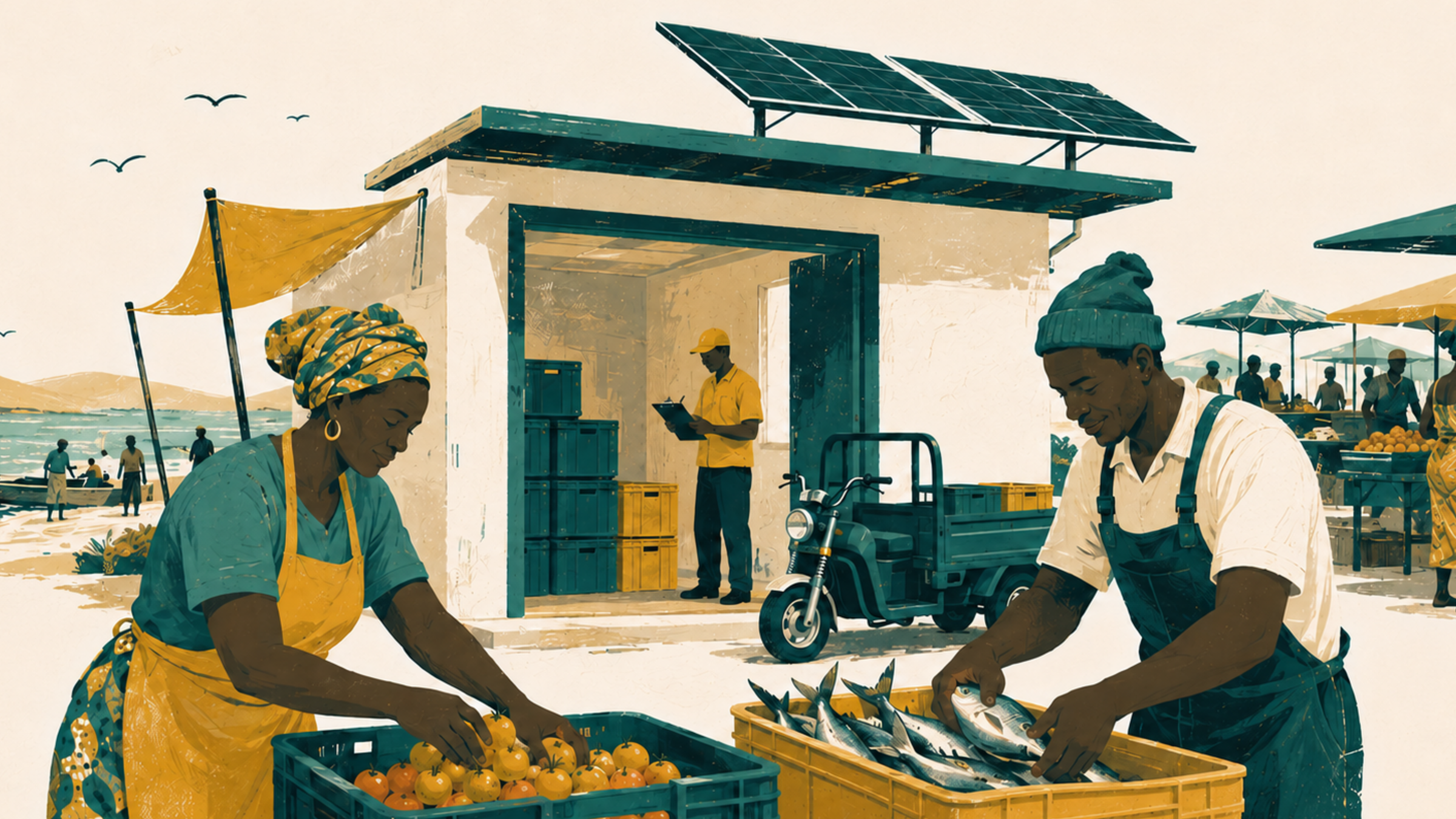
Key metrics
306.5 million — people in Africa estimated to be undernourished in 2024. [1]
37% — locally produced food estimated by the World Bank to be lost or wasted because of inadequate storage. [2]
315 million — rural people in Sub-Saharan Africa whom SEforALL estimates could benefit directly from electricity-enabled cooling and wider cold-chain access. [3]
7 times — projected growth in Africa's sustainable-cooling market by 2050, the fastest of any developing region in IFC and UNEP modelling. [6]
EXECUTIVE THESIS
The product is not cold. It is time with options.
A crate of tomatoes is not worthless when it leaves a farm. A basket of fish is not unmarketable when it reaches shore. Their value falls because time removes choices. Without cooling, a producer must sell quickly, accept the buyer who is present, limit the distance to market and absorb the cost of anything that spoils.
Cooling changes that bargaining position. It can create time to combine small volumes, sort by quality, wait for transport, reach a processor, satisfy a buyer's temperature standard or avoid a forced sale at the worst moment. Yet much cold-chain policy still begins with the object—a cold room, refrigerator, freezer, ice maker or refrigerated truck—rather than the service that makes those choices real.
The distinction matters because Africa's food-security burden is intensifying. The 2025 Regional Overview of Food Security and Nutrition, published in 2026 by FAO, the African Union Commission, the UN Economic Commission for Africa and the World Food Programme, estimates that 306.5 million Africans were undernourished in 2024. Almost 59 per cent of the continent's population, or 892.7 million people, faced moderate or severe food insecurity. [1]
Production is only part of that story. A 2025 World Bank study estimates that 37 per cent of locally produced food is lost or wasted because of inadequate storage. African food supply chains take about four times longer than European ones and can contribute up to 45 per cent of the price of basic staples. [2] Perishable foods face an even harsher clock.
The investment case is large. IFC and UNEP estimate that Africa's sustainable-cooling market could grow sevenfold by 2050. [6] The access case is larger still: analysis published by Sustainable Energy for All in March 2026 estimates that about 315 million rural people in Sub-Saharan Africa could benefit directly from electricity-enabled cooling and broader cold-chain access. [3]
But a large need does not automatically create a viable asset. A cold room can be in the right district and still have the wrong temperature range, operating hours, tariff, pack sizes, transport link, crop calendar or owner. It can preserve produce yet fail to create a buyer willing to reward quality. It can run efficiently and still sit empty.
That is why the next phase of African cold-chain investment should be built around service design. A viable facility needs enough compatible product, at the right times, from users who can reach it and see an economic return. It needs power, maintenance, trained operators, food-safety discipline, market information, transport and a tariff that covers costs without excluding small producers. It also needs low-global-warming-potential refrigerants and efficient equipment so that solving food loss does not deepen the climate and electricity problem.
STONECOMMS ORIGINAL SYNTHESIS
Cold-chain projects should be appraised as markets for time, not purchases of equipment. StoneComms proposes a six-part Cold-Chain Service Test: prove the product flow, price the extra time, secure the onward market, design dependable operations, make clean cooling bankable, and measure who captures the value. A facility that cannot pass these tests is not yet food-system infrastructure, however advanced its machinery.
This framework is derived from current evidence on African food logistics, cooling access, project utilisation, financing constraints and climate-compatible technology. [2][3][5][6][9][10] It is an analytical proposal, not an estimate of returns. The service economics will differ sharply between fish, dairy, horticulture, meat and medicines, and between export corridors, urban wholesale markets and isolated rural communities.
KEY FINDINGS
01 | Cooling is valuable because it changes market power
The most important output of cold storage is not a lower temperature. It is a wider decision window. When producers can hold safe, good-quality food, they can aggregate, grade, negotiate and reach buyers that were previously too distant or too demanding. The relevant return therefore includes reduced spoilage, but also price, quality, volume, scheduling and access to higher-value markets.
02 | Site selection is a value-chain decision, not an infrastructure allocation
SEforALL's 2026 AgCAP work combines production, infrastructure, market proximity and other geospatial variables to identify settlements with promising cooling demand. Its Madagascar analysis highlights fisheries in hot, food-insecure southern regions, but explicitly warns that data-led prospecting is only a pre-feasibility step. Business model, operator, market and community capacity still decide whether a facility works. [3]
03 | Utilisation—not installation—is the leading indicator
The ACES 2024–25 review cites a World Bank estimate that at least 96 per cent of targeted farmer communities did not use ten cold rooms financed in Rwanda in preceding years. It also reports that about 72 per cent of Rwanda's cold-storage capacity served flowers, leaving domestic food needs comparatively underserved. [5] These figures refer to a particular portfolio and national market, not a continental failure rate. Their lesson is nevertheless fundamental: commissioned equipment is not evidence of an operating service.
04 | Cooling cannot repair a missing market
Cold storage slows deterioration; it does not create demand. World Bank work on East and Southern Africa found stronger cold-chain use in export horticulture than in domestic fresh-food markets, where informal trade, small transactions, weak standards and limited willingness to pay can undermine revenue. It recommends integrating cooling with sorting, grading, packing, logistics, market links and finance. [9]
05 | Service models can lower the ownership barrier
Cooling-as-a-service, leasing, pay-as-you-go and aggregator-led models can replace a large upfront purchase with a fee linked more closely to use. Kenya's cold-chain ecosystem is already shifting towards such approaches, supported by solar refrigeration, thermal storage and digital monitoring. [11] Service finance can improve access, but only if operators achieve utilisation, collect payments and maintain equipment over time.
06 | Bad cooling can create a second infrastructure problem
Cooling already accounts for about seven per cent of global greenhouse-gas emissions, and its share could double by 2050. [7] Most developing countries are also beginning the long phase-down of high-global-warming-potential hydrofluorocarbons under the Kigali Amendment. [8] Africa therefore has to expand cooling while enforcing efficiency, technician competence, refrigerant safety and life-cycle management.
1 | WHY THIS MATTERS NOW
Hunger is rising while food is disappearing between production and sale
Africa's 2024 food-security numbers are not a temporary statistical setback. The continent's prevalence of undernourishment stood at 20.2 per cent, compared with a global average of 8.2 per cent. Moderate or severe food insecurity affected almost 59 per cent of Africans. [1] Conflict, climate shocks, debt pressure, inflation and low incomes all contribute. Better cold chains cannot solve them alone. But preventing usable food and farmer income from disappearing after production is one of the few interventions that can improve availability, livelihoods and resource efficiency together.
The World Bank's continental transport analysis reframes the problem. Africa produces more food than it did three decades ago, yet distribution remains slow, expensive and fragile. Limited storage means that less than 30 per cent of annual production can be held, while locally produced food may travel long distances through unreliable corridors. [2] For perishable foods, every border delay, broken road, market closure or power outage consumes shelf life.
Cooling is therefore part of logistics resilience, not a substitute for it. A refrigerated room beside an impassable road merely postpones the loss. A truck without reliable handling at either end breaks the temperature chain. A freezer without spare parts becomes a cupboard. The unit of policy should be the journey of the product and the operating decisions around it.
The timing is also favourable. Solar generation, more efficient compressors, thermal storage, remote monitoring and digital payments have widened the range of places where reliable cooling can operate. In June 2026, GOGLA reported that productive-use applications—including cold storage—would remain an important growth area for off-grid solar, while warning that investment conditions and subsidy design remain challenging. [12]
At the same time, public programmes are becoming more analytical. SEforALL's open-source AgCAP tool is being used in Madagascar and expanded to Mozambique to identify promising sites at settlement level. FAO's 2025–26 Food Coalition work is developing loss baselines and piloting solar cold rooms, storage and market links in selected African countries. [3][10] These initiatives create an opportunity to replace generic equipment targets with a more disciplined project pipeline.
2 | THE ECONOMIC PRODUCT IS AN OPTION
Cooling makes a market thicker
Without storage, a seller's market may consist of the buyers physically present before the product deteriorates. That produces a familiar asymmetry: the buyer can wait; the farmer or fisher cannot. The price discount is partly payment for taking spoilage risk and arranging onward logistics.
An extra day of safe storage can alter four variables.
First, it can increase market reach. Produce can travel farther or wait for a scheduled vehicle rather than using the first available transport.
Second, it can enable aggregation. Small quantities from many producers can become a commercially relevant load, reducing unit logistics costs and attracting larger buyers.
Third, it can preserve quality and safety. Better handling can raise the share of product that meets processor, retailer or export specifications.
Fourth, it can improve negotiating time. Sellers are less compelled to accept a distressed price before sunset.
These gains are related but not interchangeable. A facility may reduce physical loss without raising farmer income if traders capture the value. It may extend shelf life without improving price if the destination market is saturated. It may serve an export chain well but be unaffordable for domestic vendors.
The Lari Horticultural Cooperative near Nairobi illustrates the upside without proving a general return. UNEP reports that its 179 farmers previously lost up to 40 per cent of crops after harvest. Following training and access to a cold room, insulated vehicle and refrigerated truck, losses fell to a few per cent and farmer incomes rose by 50 per cent. [4] This is a project account, not an independent impact evaluation. Its useful lesson is the bundle: the cooperative received logistics, operational training and pricing support as well as equipment.
3 | WHY COLD ROOMS BECOME WHITE ELEPHANTS
A good machine can fail six different markets
Cold-chain proposals often use annual production and estimated loss to size a facility. Those numbers can conceal the operating reality.
A district may produce a large volume over a year, but the harvest may arrive in a short seasonal peak. Different crops may require incompatible temperatures and humidity. Farmers may live too far away to justify transport of small loads. Electricity may be nominally available but too unreliable for temperature control. Users may prefer same-day cash to delayed sale, even when delayed sale could fetch more. A processor may demand grades or volumes the producer group cannot supply. A donor may pay for capital expenditure but leave no working capital for crates, fuel, packaging, repairs or salaries.
The ACES review's Rwanda evidence is especially instructive. The cited non-use of cold rooms does not mean farmers reject cooling. It means the equipment did not become part of an attractive transaction for most of the intended users. [5]
This is why utilisation should be measured before claims about capacity. Useful indicators include kilogram-hours sold, occupancy across seasons, repeat-user rate, temperature compliance, product saved, price uplift, average distance served, maintenance downtime and operating-cost recovery. A project that reports only cubic metres installed or units commissioned has described an asset, not its development performance.
Location analysis can improve the odds but cannot replace fieldwork. AgCAP can rank settlements using production, infrastructure and market variables. [3] A bankable feasibility study must then observe actual harvest timing, buyer behaviour, handling practices, willingness to pay, gendered control of income, transport costs, power quality and operator capability.
4 | FROM HARDWARE TO SERVICE
Sell the smallest dependable unit of time
Ownership models ask a farmer, cooperative or trader to purchase an asset whose utilisation and maintenance they may not be equipped to manage. Service models move some of that risk to a specialist operator.
The service unit can vary: a crate per day, kilogram per hour, pallet per week, batch of ice, refrigerated journey, or guaranteed temperature window. Digital access and metering can support billing, but simple contracts may be more appropriate where connectivity and record-keeping are weak. The essential point is that users pay for preservation and handling rather than financing the entire machine.
The operator's business is more complex than refrigeration. It must forecast demand, schedule users, manage food separation and hygiene, maintain equipment, control temperature, arrange backup power, collect fees and often coordinate transport or buyers. That creates local jobs and enterprise opportunities, but it also means the operating model needs as much due diligence as the technology supplier.
Anchors can stabilise utilisation. A dairy cooperative with daily throughput, fish landing site, urban wholesale market, processor, supermarket or institutional buyer may provide base demand. Smaller producers can then use spare capacity. Public health storage can sometimes share infrastructure or maintenance capabilities, though food and medical products require strict separation and specialised standards.
Service contracts should clarify what happens when cooling fails. Who bears the value of spoiled product? How is temperature recorded? What uptime is guaranteed? Who owns data? What remedies exist? Without these answers, users may carry the downside while the operator claims the upside.
5 | THE COLD-CHAIN SERVICE TEST
A six-part appraisal for investable cooling
The following framework is a StoneComms original synthesis. It turns the evidence into a practical pre-investment sequence. [2][3][5][6][9][10]
1. FLOW | Is there enough compatible product at usable intervals?
Measure daily and seasonal volumes, not annual totals alone. Record temperature needs, harvest or landing times, current handling, loss points, transport distance and variability. Identify anchor flows and the minimum occupancy required for economic operation.
2. TIME | What is an extra hour or day actually worth?
Estimate avoided loss, quality retention, price improvement, aggregation savings and access to different buyers. Separate benefits to producers, traders, operators and consumers. Test whether users prefer immediate cash even when storage has a higher expected return.
3. MARKET | Is there a credible transaction after storage?
Name the buyers, quality standards, volumes, schedules, packaging, payment terms and logistics. Cooling should sit inside an onward-market plan. Letters of intent, trial purchases and buyer data are stronger evidence than general claims about urban demand.
4. OPERATE | Can one entity deliver dependable, safe service?
Assess governance, staffing, maintenance contracts, spare parts, technician access, temperature monitoring, food safety, backup power, user booking and dispute resolution. Model peak seasons and low-utilisation months. The operator should have both incentives and authority to protect service quality.
5. CLEAN FINANCE | Does capital match the service risk?
Choose energy-efficient equipment and Kigali-compatible refrigerants. Combine grants or results-based finance for market creation and inclusion with leasing, working capital, risk sharing or commercial debt where contracted cash flows justify it. Tariffs must fund maintenance and eventual replacement, not only today's electricity bill.
6. VALUE | Who gains, who pays and what will be verified?
Track utilisation, physical loss, quality, prices, income, energy use, refrigerant leakage, uptime and food-safety performance. Disaggregate participation and benefits by gender and firm size. Verify whether value reaches producers or is captured elsewhere in the chain.
A project need not pass every test at first screening. A failed test reveals the missing preparation: market development, data, operator support, finance, infrastructure or regulation. The purpose is to prevent capital from arriving before the service is ready.
6 | FINANCE THE OPERATING SYSTEM
Capital expenditure is the beginning, not the business model
IFC and UNEP estimate that closing existing cooling-access shortfalls for households and small firms in developing economies requires US$400–800 billion, before accounting for future demand. They identify revolving funds, working-capital loans, results-based finance, risk-sharing facilities, equity, cooling bonds and carbon finance among the instruments that may be needed. [6]
For rural cold chains, the financing stack should follow risk.
Public and grant capital can fund loss baselines, site screening, community engagement, operator training and early market trials—activities that generate information but not immediate cash flow. Concessional or blended finance can support first-of-a-kind facilities, efficient technology and service expansion where public benefits exceed private revenues. Commercial capital becomes more credible when utilisation records, buyer contracts, payment performance and maintenance systems are visible.
Working capital deserves particular attention. The operator may need to buy crates, packaging, ice or fuel, pay staff and aggregate produce before buyers settle invoices. A technically sound cold room can fail because the enterprise runs out of cash between harvest and payment.
Results-based finance should reward outcomes that matter: verified use, product kept within temperature, losses avoided, reliable operation and service to underserved users. Paying only for installation can encourage placement without adoption. Paying only for tonnes stored can encourage volume while ignoring whether producers receive value.
7 | THE CLIMATE DISCIPLINE
Africa should not lock in yesterday's cooling
Expanding cooling with inefficient machines and high-global-warming-potential refrigerants would exchange one loss for another. Electricity demand would rise, weak grids would face additional peaks, and refrigerant leakage would deepen warming.
The Kigali Amendment creates a clear direction. Most developing countries froze HFC use from 2024 before phased reductions, and global HFC use is expected to fall by 80–85 per cent by 2047. Full implementation could avoid up to 0.5°C of warming by 2100; combining the phase-down with higher efficiency could nearly double the benefit. [8]
The engineering response is not simply to specify a new refrigerant. Equipment efficiency, system design, insulation, thermal storage, solar generation, ventilation, shading, maintenance and technician safety all matter. Natural refrigerants such as propane or ammonia can have low climate impact but require appropriate design, training and safety practice.
National cooling plans and climate commitments can help coordinate standards, technician training, customs enforcement, minimum energy performance and investment pipelines. UNEP's 2025 NDC Cooling Guidelines recommend fully costed action plans, Kigali-compliant refrigerant transition, efficiency standards and measurement systems. [7]
For financiers, energy and refrigerant performance should become credit variables. Efficient equipment lowers operating cost and can improve repayment capacity. Reliable maintenance protects both food and asset value. Life-cycle refrigerant management reduces regulatory and environmental risk.
8 | PAN-AFRICAN SCALABILITY
Replicate the test, not the machine
The same cold-room design should not be copied across the continent. The same appraisal discipline can be.
Madagascar's small-scale fisheries offer a high-loss, heat-exposed case where ice making and freezing may protect a nutritionally important catch. SEforALL estimates that small-scale fisheries supply 59 per cent of national fish production and highlights Atsimo Andrefana as a promising region because production, extreme heat and food insecurity overlap. [3]
Kenya offers more mature horticulture and dairy ecosystems, emerging service companies and policy interest. Its opportunity is to scale business models while improving standards, technician capacity and finance. [4][11]
Rwanda offers institutional capacity and a regional knowledge hub through ACES, but its underused assets show the importance of domestic market demand and operator design. [5]
Landlocked production corridors need storage linked to dependable road and border performance. Coastal fisheries may need ice, landing-site handling and urban distribution. Dense cities may support multi-user wholesale hubs. Remote communities may require solar-direct systems with thermal storage and a narrower set of products.
Regional trade adds another layer. Temperature standards, packaging, sanitary rules, vehicle requirements and border procedures can either extend the value of cooling or consume the time it creates. AfCFTA implementation should therefore treat cold-chain interoperability and border dwell time as food-security infrastructure, not only trade facilitation.
9 | IMPLICATIONS FOR POLICY AND INVESTMENT
1. Replace installation targets with service targets
Governments and funders should report utilisation, uptime, repeat use, temperature compliance, loss reduction and value distribution. Capacity installed is an input.
2. Join agriculture, energy and trade planning
Cooling demand should inform electricity-access plans; crop and fisheries strategy should inform cooling sites; trade corridors should protect the shelf life created upstream. Cross-ministerial planning must reach the project level.
3. Procure operating capability with equipment
Contracts should include training, spare parts, maintenance response, remote support, refrigerant management and multi-year performance obligations. Local technician networks are infrastructure.
4. Let anchors pull smaller users into the system
Stable demand from cooperatives, processors, institutions or wholesalers can support commercial operation. Access rules and tariffs should still protect smaller producers from exclusion.
5. Use public finance to buy evidence and inclusion
Concessionality is most useful where it resolves early uncertainty, serves thin markets or pays for public benefits. It should decline as utilisation and cash-flow evidence improve.
6. Require a clean-cooling pathway
Every publicly supported facility should disclose energy performance, refrigerant choice, technician arrangements, backup power and end-of-life management.
7. Test who controls the sale
If women perform production and handling but do not control revenue, loss reduction may not translate into their economic agency. Project monitoring must follow income and decision-making, not participation counts alone.
11 | COMMISSIONABLE RESEARCH AGENDA
The next useful commission is a comparative study of what makes African cooling services reach durable utilisation.
A 24-week programme could examine twelve operating and underperforming sites across four value chains—fisheries, dairy, horticulture and urban wholesale—in four to six countries. It should include facilities funded by donors, commercial providers, cooperatives and public market authorities.
The evidence package should combine timestamped product flows, temperature logs, energy use, downtime, tariffs, maintenance costs, payment records, buyer contracts, price and quality data, travel times, user interviews and gendered control of revenue. Underperforming facilities are essential to the sample; studying only survivors would bias the findings.
Outputs should include a commodity-level service-economics model; utilisation and breakeven benchmarks; operator archetypes; model service contracts; financing pathways; a clean-cooling compliance checklist; site-screening guidance; and a public results framework that distinguishes installation, operation and development value.
The likely clients are agriculture and energy ministries, development-finance institutions, climate funds, foundations, food companies, logistics providers, off-grid solar firms and regional trade organisations. Their shared question is practical: where can cooling create enough paid-for time to sustain itself, and what public action is needed where the private return falls short of the social value?
12 | CONCLUSION
The cold-chain gap is often photographed as an empty space where a machine should be. The more important absence is an operating system.
Africa needs cold rooms, ice makers, refrigerators and temperature-controlled transport. It also needs product aggregation, buyers, working capital, food-safety rules, dependable power, maintenance, technicians, viable tariffs and institutions able to learn from utilisation data.
The difference is visible in the hour after harvest. Without a service, that hour narrows a producer's options. With a dependable cold chain, it can widen them—towards a better buyer, safer food, less waste and a more resilient rural economy.
The investment question is therefore not how many machines can be installed. It is how much valuable time can be sold, to whom, under what conditions, and who benefits when the clock slows down.
Methodology
METHODOLOGY AND EVIDENCE NOTE
This paper is based on desk research completed on 3 September 2026. It prioritises primary and authoritative sources published by FAO, the African Union Commission, UNECA, WFP, the World Bank, UNEP, IFC, the Ozone Secretariat, SEforALL, ESMAP and GOGLA. A recent peer-reviewed synthesis indexed by FAO AGRIS was used to check the wider post-harvest-loss literature. Claims were triangulated where possible; project-reported outcomes and modelled estimates are identified as such. No proprietary data, fieldwork or stakeholder interviews were used.
Limitations
10 | RISKS AND LIMITATIONS
The evidence base is improving but remains uneven. Continental food-loss estimates combine commodities and methods that are not directly comparable. The World Bank's 37 per cent figure is a modelled continental estimate, not a measured loss rate for every product or country. [2]
Project case studies often report before-and-after outcomes without randomised comparison or full financial accounts. The Lari cooperative's reported loss and income improvements are promising but should not be transferred mechanically to other settings. [4]
Geospatial screening can overstate viability when informal flows, buyer behaviour and operating capability are missing from datasets. SEforALL appropriately presents AgCAP as a way to prioritise pre-feasibility, not replace it. [3]
The Cold-Chain Service Test is a conceptual synthesis. Its components require field validation and commodity-specific thresholds. It does not determine whether a project should be public, private or cooperative, nor whether cooling is the best intervention. For some dry staples, hermetic storage, roads, market information or processing may produce better returns.
Finally, preserved food is not automatically affordable food. Cooling costs can be passed to consumers, and high-value market links can redirect nutritious products away from local buyers. Distributional outcomes must be tested explicitly.
Sources
<h2 id="source-note">SOURCE NOTE</h2> <p>Public evidence was checked through 3 September 2026. Continental estimates, geospatial screening results and project-reported outcomes are presented with their stated scope and should not be treated as uniform country-level impacts. The Cold-Chain Service Test is explicitly labelled as StoneComms original synthesis.</p>
REFERENCES AND DATA NOTES
[1] FAO, ECA, AUC and WFP (2026), Africa Regional Overview of Food Security and Nutrition 2025. Latest reported food-security estimates are for 2024.
[2] World Bank (2025), Improving Transport Connectivity for Food Security in Africa: Strengthening Supply Chains. Continental estimates are modelled and should not be read as uniform country or commodity rates.
[3] Sustainable Energy for All (19 March 2026), Sustainable Cooling Access for Agriculture & Fisheries in Sub-Saharan Africa. Includes AgCAP method and Madagascar application.
[4] UNEP (29 September 2025), Can refrigerated vans and cold storage rooms help end an epidemic of food loss in Africa?. Lari outcomes are programme-reported.
[5] Africa Centre of Excellence for Sustainable Cooling and Cold-Chain / UNEP (June 2025), Sustainable Cooling and Cold-Chain Solutions: Review 2024–25. The Rwanda utilisation figures are attributed in the review to World Bank-funded facilities.
[6] IFC and UNEP Cool Coalition (25 September 2024), Cooler Finance: Mobilizing Investment for the Developing World's Sustainable Cooling Needs.
[7] UNEP Cool Coalition (23 June 2025), NDCs cooling guide: Guidance for integrating the cooling sector into NDCs.
[8] UNEP Ozone Secretariat (25 February 2026), Kigali Amendment overview.
[9] World Bank (2022), COOL MOVE: An integrated solution focusing on cold-chain investments to reduce food loss in East and Southern Africa.
[10] FAO Food Coalition (2025–26), Food Loss and Waste in selected African countries.
[11] GOGLA (5 December 2025), Catalyzing Cold Chain Solutions in Kenya.
[12] GOGLA (18 June 2026), GOGLA 2025 Annual Report.
[13] Mawoneke, K.G. et al. (2025), From farm to fork: a review of strategies for sustainable reduction of post-harvest losses in Sub-Saharan Africa, Cogent Food & Agriculture, 11(1).