Key metrics
Nearly 300 projects — nature-based-solution projects in Sub-Saharan Africa assessed in the World Bank/WRI report prepared with African Development Bank collaboration. [3]
US$21 billion+ — cumulative funding identified for nature-based solutions in Sub-Saharan Africa between 2012 and 2023. [3]
2:1 to 8:1 — benefit-cost ratios reported by GCA for well-designed nature-based adaptation solutions; not a guaranteed project return. [2]
US$5.3 billion a year — African trade estimated by GCA to be exposed to climate disruption at ports. [5]
EXECUTIVE THESIS
A seawall is an asset. The mangrove in front of it must be treated as one too.
Concrete is easy to recognise as infrastructure. It has drawings, quantities, a contractor, a completion certificate and a maintenance schedule. A wetland that absorbs floodwater, a mangrove belt that weakens waves or a restored slope that protects a railway can perform an equally practical service, but its institutional identity is less certain. It may sit outside the project boundary, across several landholdings or under the care of people who are not party to the infrastructure contract.
That ambiguity has consequences. The engineered structure is financed as capital; the ecosystem is often funded as a project. The structure has an operator; the ecosystem has stakeholders. The structure is inspected against a specification; the ecosystem may be monitored through hectares planted, even when survival, hydraulic performance or protective value matters more.
This is becoming a serious investment problem for Africa. Climate exposure is rising while infrastructure budgets remain constrained. The World Bank, World Resources Institute and African Development Bank reviewed nearly 300 nature-based-solution projects in Sub-Saharan Africa and found that investment grew by about 15 per cent a year between 2012 and 2023, surpassing US$21 billion in cumulative funding. The same review found that policy, technical capacity, land rights, long-term finance and monitoring still constrain scale. [3]
The financial case can be strong. The Global Center on Adaptation reported in January 2026 that well-designed nature-based solutions can produce benefit-cost ratios of 2:1 to 8:1. Its Africa-focused modelling suggests that targeted investment of US$3-4 billion could avoid more than US$7 billion in climate losses by 2100. Those figures are modelled ranges, not promised project returns, but they establish a credible reason to test nature alongside engineered alternatives rather than after them. [2]
The urgency is visible at the edge of the continent. African ports handle about 90 per cent of its trade. GCA estimates that US$5.3 billion of annual trade is already exposed to climate disruption at ports, with direct damages projected at US$530-680 million a year by 2050. Adaptation measures could cut climate-related risk by as much as 70 per cent in the assessed cases. [5] A mangrove, dune, wetland or floodplain that reduces loading on a port, road or drainage system is therefore not decorative nature. It is part of the service architecture of trade.
STONECOMMS ORIGINAL SYNTHESIS
Nature becomes infrastructure when six things are made explicit: the hazard it addresses, the service it must deliver, the physical and social boundary of the asset, the steward responsible for performance, the finance that sustains it, and the evidence used to verify results. StoneComms calls this the Living Infrastructure Contract. Without those six terms, a nature-based solution remains vulnerable to becoming a short-lived environmental project beside a long-lived engineered asset.
The framework is derived from current African project evidence and finance guidance. [2][3][5][6][7][8] It is not an engineering standard or an estimate of returns. The appropriate solution will vary sharply between a coastal port, a Sahelian city, a highland road, a river basin and a dense informal settlement. In some locations conventional engineering will remain essential; in many, the strongest design will combine living and built systems.
KEY FINDINGS
01 | The missing link is not proof that nature works; it is proof of service
Project sponsors often count trees, hectares or seedlings because they are visible outputs. Infrastructure investors need a more demanding chain: which hazard changes, by how much, over what area, for which assets and people, under what climate scenario, and with what confidence? Ecological condition matters because it is the mechanism; avoided disruption, lower maintenance and safer communities are the service.
02 | Green and grey should be designed as one system
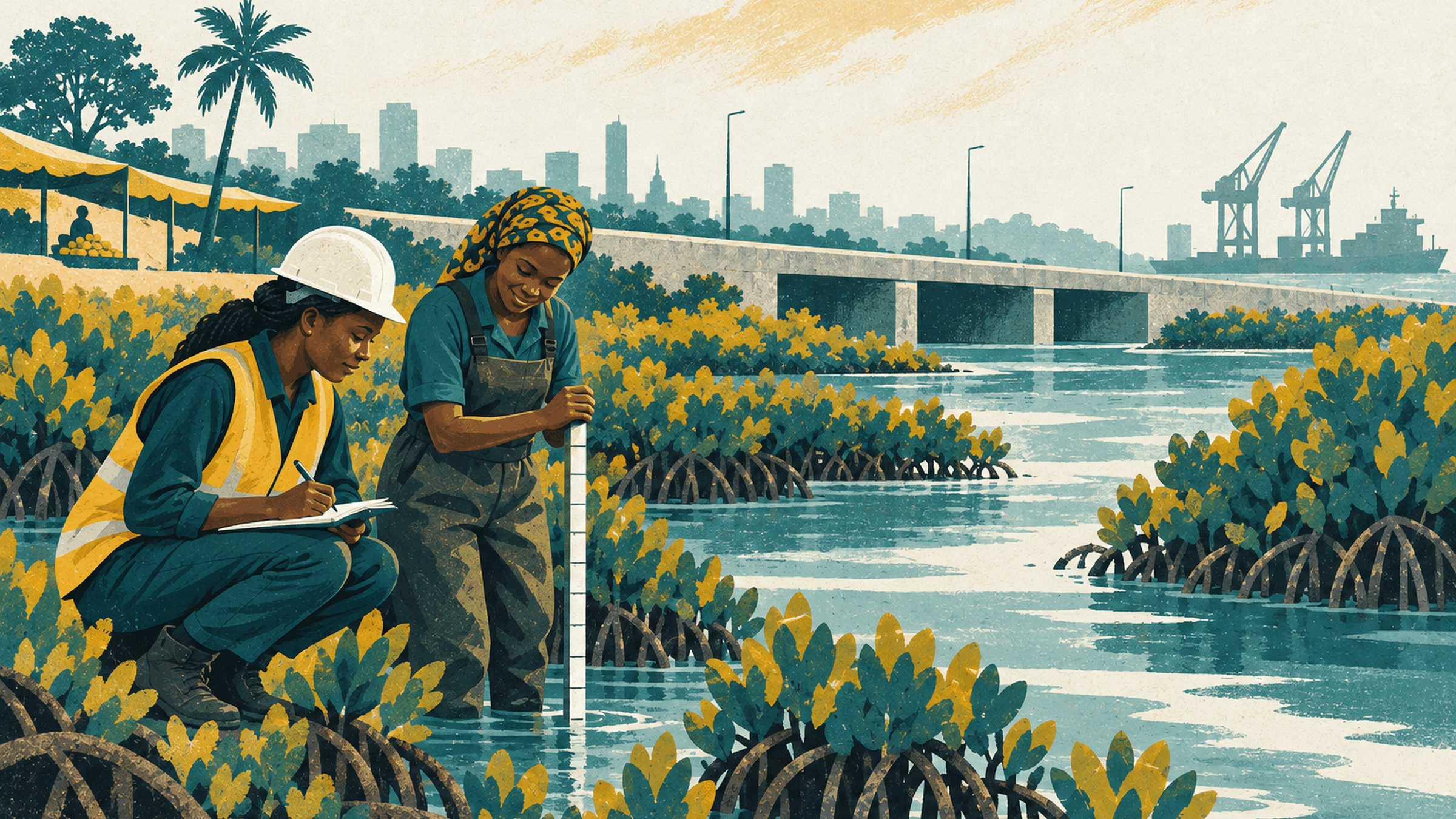
A mangrove belt can reduce wave energy before it reaches a seawall. A floodplain can store water before it reaches a culvert. Urban green space can slow runoff before it enters a drain. These are not substitutes in every case. Their value often lies in reducing the load, height, repair frequency or failure probability of engineered infrastructure. [1]
03 | Maintenance is ecological and institutional
Living assets change. Plants mature, channels silt, invasive species spread, shorelines move and human use shifts. Performance therefore depends on monitoring, adaptive management and a steward with authority to act. A three-year planting grant cannot credibly protect a 30-year road unless the operating institution and funding continue after the grant closes.
04 | Land and livelihoods are design variables
The ecosystem may sit on customary, communal, private or contested land. People may fish, farm, graze, gather materials or build livelihoods within it. A protective scheme that restricts access without legitimate agreements can transfer climate risk from an infrastructure owner to a community. Ghanaian evidence reviewed by the World Bank shows why clear rights and ownership arrangements are central to delivery. [3]
05 | Public finance should buy preparation, not only planting
Private capital can participate where benefits create cash flows or protect revenue-generating assets, but many resilience benefits are public, distributed and difficult to monetise. Public and concessional finance are therefore most valuable when they fund risk mapping, ecological and engineering design, land agreements, community participation, baselines, monitoring and early performance evidence.
06 | A portfolio must include failure and underperformance
Nature-based solutions are often presented through successful cases. Investment-grade learning also requires projects where plants died, land could not be secured, maintenance stopped, benefits accrued elsewhere or performance could not be verified. The question is not whether nature is good. It is which designs work, where, for whom and for how long.
1 | WHY THIS MATTERS NOW
Africa is building assets for a climate their design histories did not anticipate
On 25 August 2026, UNEP argued that green and engineered infrastructure must be planned together as climate impacts become more unpredictable. It described roads being washed away before they are paid off, ports exposed to surges and power systems stressed by heat. The speech accompanied a five-year initiative with Italy and the OECD to integrate nature-based solutions into infrastructure planning; more than 100 applications had been received from Africa and Central Asia in its first call. [1]
The timing matters because capital decisions made now will define exposure for decades. Roads influence settlement, drainage and land value. Ports anchor corridors and industrial zones. Power lines cross slopes, forests and floodplains. Urban drainage fixes where water is accelerated, stored or discharged. If ecological systems are considered only after alignments and budgets are fixed, the remaining interventions may be smaller, costlier or impossible.
The finance system is also looking for credible pipelines. UNEP's State of Finance for Nature 2026 estimates that US$220 billion flowed to nature-based solutions globally in 2023, while US$7.3 trillion supported activities it classifies as nature-negative. Private finance supplied only US$23 billion of positive flows. UNEP estimates that annual nature investment must reach US$571 billion by 2030 to meet climate, biodiversity and restoration goals. These are global figures using UNEP's methodology, not an African project budget. Their relevance is the imbalance: finance is not merely scarce; existing investment decisions often increase the future cost of protection. [4]
For African governments, the practical choice is not between nature and economic development. It is whether roads, cities, ports and utilities are designed to work with hydrology, shorelines, soils and vegetation or repeatedly pay to fight them.
2 | THE SERVICE IS PROTECTION, NOT PLANTING
Outputs are easiest to count where outcomes are hardest to attribute
A planted hectare is not a unit of flood protection. Its effect depends on location, species, survival, density, soil, tidal exchange, upstream flows, extreme events and the asset behind it. A wetland can be ecologically valuable while offering little protection to the particular road in a project appraisal. Conversely, a narrow intervention at a hydraulic bottleneck may have greater protective value than a larger but poorly located scheme.
The evaluation problem has three layers.
First is the ecological mechanism: vegetation roughness, infiltration, sediment retention, slope stability, evaporative cooling or wave attenuation.
Second is the infrastructure effect: lower peak flow at a culvert, reduced wave load at a seawall, fewer heat-related operating interruptions, less sediment entering a reservoir or lower erosion near a road.
Third is the economic and social result: avoided repair, fewer closure days, safer homes, more reliable trade, protected livelihoods or reduced emergency spending.
Each layer needs evidence, but they should not be collapsed into one confident number. Avoided losses are counterfactual: they describe damage that did not occur. Models can estimate them, while long-term monitoring can improve confidence, but attribution remains sensitive to weather, development patterns and maintenance of the engineered asset.
GCA's 2:1 to 8:1 benefit-cost range is therefore best used as a reason for disciplined appraisal, not a generic multiplier applied to every wetland or mangrove. [2] A project should show its own baseline, hazard model, service pathway, uncertainty and distribution of benefits.
3 | DESIGN THE HYBRID ASSET
Nature can lower the load before concrete carries what remains
The strongest green-grey designs allocate functions deliberately. A wetland stores routine flows while a drain conveys extremes. Mangroves and dunes attenuate waves while a seawall protects critical facilities. Vegetated slopes reduce erosion while culverts and retaining structures protect points of failure. Trees and shade lower urban heat exposure while power and cooling systems protect critical services.
This changes engineering questions. Instead of asking whether a nature-based solution can replace a structure, the project asks how the combination affects whole-life cost, redundancy and failure mode. A living component may improve over time as vegetation establishes, but it may also be damaged by drought, pollution or land conversion. A concrete component has a defined design capacity, yet can fail abruptly when that threshold is exceeded. Together they may provide layers of protection if each is sized, monitored and maintained against a shared objective.
N'Djamena illustrates the approach at city scale. The World Bank-financed urban resilience project combines green areas that absorb and manage rainwater with conventional drainage. The expected benefits extend beyond flood reduction to urban cooling and public space. [3][7] Those co-benefits are real, but they also complicate ownership: the drainage authority, parks department, land agency and community users may each control a different part of the service.
At ports, the boundary extends inland. GCA's 2025 assessment frames port resilience as a trade-corridor issue because disruption travels through road, rail, logistics, energy and urban systems. [5] Protecting the quay while the access road floods preserves an asset but not its economic service.
4 | THE LIVING INFRASTRUCTURE CONTRACT
Six tests for an investable and accountable protective service
The following framework is a StoneComms original synthesis derived from the cited African project, infrastructure and finance evidence. [2][3][5][6][7][8]
1. HAZARD | What physical risk is changing?
Define the current and future hazard: flood depth and duration, wave energy, erosion, heat, sediment, drought or slope instability. State the climate horizon and uncertainty. Identify the engineered assets, services, businesses and communities exposed. A generic claim of resilience is not a design basis.
2. SERVICE | What must the living system deliver?
Translate ecology into a measurable protective function: cubic metres stored, peak flow reduced, shoreline stabilised, temperature moderated, sediment retained, closure days avoided or asset life extended. Use ranges where evidence is uncertain. Separate ecological health indicators from infrastructure-service indicators while showing how they connect.
3. BOUNDARY | Where does the asset begin and who is inside it?
Map the hydrological or coastal system, not only the construction site. Record land tenure, customary use, upstream and downstream effects, livelihoods, settlement and the distribution of benefits and restrictions. The project boundary must include the people whose behaviour and rights determine whether the ecosystem can function.
4. STEWARD | Who is responsible after establishment?
Name one accountable coordinating entity and define roles for infrastructure operators, environmental agencies, municipalities, communities and specialist contractors. Set inspection frequency, ecological thresholds, maintenance actions, emergency responsibilities and dispute routes. Participation should confer influence and compensation where people bear costs; it should not be used as a substitute for professional accountability.
5. FINANCE | What pays for preparation and long-term performance?
Match funding to the benefit. Public budgets and concessional finance can pay for public protection, early studies, land agreements and inclusion. Asset owners may pay where ecological measures reduce their expected losses or insurance cost. Results-based payments may reward verified service, while carbon or biodiversity revenue can provide supplementary income where integrity standards are met. No secondary revenue should be assumed to fund maintenance until price, eligibility, transaction cost and permanence risk are tested.
6. PROOF | How will performance and fairness be verified?
Establish ecological, engineering, economic and social baselines before intervention. Monitor survival and condition, but also the service delivered, asset downtime, maintenance cost, affected livelihoods and who receives benefits. Publish material assumptions and failures. Build triggers for adaptive management when performance falls outside the expected range.
Passing the test does not prove that nature should be used. It makes the choice comparable. A conventional design, a nature-based design and a hybrid should be assessed against the same hazard, service level, time horizon, distributional safeguards and whole-life cost.
5 | WHO OWNS AN ASSET THAT GROWS?
Stewardship is the operating company of living infrastructure
Traditional construction contracts favour a definable handover. Living systems do not finish at practical completion. A planted shoreline may take years to reach useful density. A restored wetland may need water-control adjustments. A slope may require replanting after drought. Monitoring is therefore part of operations, not a post-project evaluation.
This does not mean responsibility should be pushed informally onto communities. Local knowledge and day-to-day presence are valuable, and community organisations may be excellent delivery partners. But asking residents to protect a national road, port or urban drainage asset without secure rights, resources and authority externalises public infrastructure cost.
The contract should identify who can act when the system is threatened by dumping, encroachment, grazing, invasive species or upstream development. It should fund that action. Where restrictions alter livelihoods, compensation and alternatives belong in the infrastructure budget. The ethical question and the performance question are the same: a system that depends on cooperation cannot be resilient if its agreements are illegitimate.
6 | FINANCE THE RISK REDUCTION
The cash flow often sits in a different institution from the benefit
A port authority may benefit from fewer closure days while a municipality controls the mangrove land. A road agency may save on repairs while farmers surrender floodplain use. An electricity utility may benefit from protected transmission while a watershed agency manages the slope. These split incentives help explain why economically valuable projects remain unfinanced.
Public finance has three distinct jobs.
The first is preparation: hazard data, ecological surveys, engineering, land and rights work, community agreements, valuation and procurement design.
The second is public value: benefits such as safer neighbourhoods, biodiversity, cooling and livelihood resilience that cannot be fully charged to a single asset owner.
The third is risk absorption: supporting early projects until performance evidence, delivery capability and contracting models become credible.
Commercial and institutional capital becomes more plausible where a protected asset has revenue, maintenance savings or measurable avoided disruption. GCA recommends blended finance, guarantees and concessional instruments to address early risk, alongside stronger valuation and national project pipelines. [2] The crucial discipline is to avoid using a sophisticated financing label to hide a weak service model.
Global finance also creates a warning. UNEP's finding that nature-negative finance outweighs positive flows by 30 to one means a resilience project may be repairing damage encouraged elsewhere in the investment system. [4] Screening major infrastructure for ecosystem loss, hydrological change and induced development should therefore occur before compensatory nature finance is celebrated.
7 | PAN-AFRICAN SCALABILITY
Replicate the contract, not the ecosystem
Sub-Saharan Africa's nearly 300 reviewed projects span different hazards and institutions. [3] Their common lesson is not a continental catalogue of solutions. It is a common discipline for defining service and responsibility.
In coastal West and East Africa, ports and cities may combine mangroves, dunes, drainage and engineered defences. Trade continuity, informal settlements, fisheries and land pressure must be examined together.
In Sahelian cities, urban green space, retention areas and restored channels may reduce flood and heat risk, but water availability, rapid settlement and municipal maintenance capacity shape feasibility. N'Djamena's hybrid drainage approach is relevant because it combines functions rather than copying a coastal model. [3][7]
In East African highlands, slope restoration and catchment management can protect roads, railways, reservoirs and hydropower systems. Land holdings, farming practice and upstream-downstream payments become central.
In river basins and deltas, floodplain reconnection may reduce downstream peaks but restrict cultivation or settlement in the protected area. The political economy of land can be more difficult than the engineering.
In fragile and conflict-affected settings, the World Bank review suggests modular projects with strong local engagement may be more workable than institutionally complex schemes. [3] Yet local delivery must still connect to reliable finance and authority.
The project typology should therefore follow hazard, service, stewardship and finance - not a generic label such as restoration.
8 | IMPLICATIONS FOR POLICY, CAPITAL AND IMPLEMENTATION
1. Put living systems inside the infrastructure business case
Appraise nature at concept stage alongside alignment, drainage, materials, land, safety and climate scenarios. Late environmental additions cannot reliably change the core design.
2. Procure a service level, not a planting target
Contracts should specify establishment, condition, protective performance, monitoring and adaptive maintenance. Payment milestones should reflect survival and service over time.
3. Create an accountable steward before construction
The institution responsible for performance, land agreements and maintenance must exist before capital is committed. Multi-agency committees need a named lead and decision rights.
4. Budget beyond the political opening
Whole-life appraisal should include monitoring, ecological management, community agreements and recovery after extreme events. Short grants should not create long liabilities without a funded handover.
5. Make distribution visible
Record who is protected, who gives up access, who is paid, who maintains the asset and whose property or business receives the largest avoided loss. Gender, income, tenure and livelihood effects should be part of performance reporting.
6. Build a comparable evidence portfolio
Development financiers should use common minimum fields for hazard, service, cost, land, stewardship, maintenance and outcomes. Publish underperformance as well as success so future projects can price risk honestly.
7. Screen nature-negative capital at the same gate
It is inefficient to finance restoration while approving adjacent infrastructure or subsidies that destroy the protective system. Environmental and climate screening should test cumulative hydrological and ecosystem effects.
9 | RISKS, COUNTERARGUMENTS AND LIMITATIONS
Nature-based solutions are not automatically cheaper, safer or fairer. Land acquisition, restoration, monitoring and long establishment periods can be expensive. Performance can be uncertain under climate conditions outside the historical record. Some critical assets require protection levels that only engineered structures can provide.
Valuation can exaggerate benefits by adding overlapping co-benefits, choosing optimistic climate scenarios or claiming avoided losses that accrue far beyond the paying institution. Benefit-cost ratios from portfolios should not be transferred to individual projects without local appraisal.
Ecological projects can also create displacement, restrict resource access or enable green gentrification. Community participation does not eliminate unequal power. Rights, compensation, grievance and benefit-sharing require enforceable arrangements.
The African investment figures cited here are drawn from institutional portfolio reviews and models using different scopes and time periods. The US$21 billion figure is cumulative funding identified across Sub-Saharan African nature-based-solution projects from 2012 to 2023. [3] The US$3-4 billion investment and more than US$7 billion avoided-loss figures are GCA modelled estimates to 2100. [2] They are not directly comparable.
This paper is a desk study. It contains no original engineering, ecological survey, financial model, insurance data, community interviews or project audit. The Living Infrastructure Contract is a research and appraisal hypothesis requiring testing against operating and failed projects.
10 | COMMISSIONABLE RESEARCH AGENDA
The next useful commission is a comparative study of whether African green-grey assets continue to provide service after project closure.
A 24-week programme could examine twelve projects across ports, urban drainage, roads or railways and catchment-linked energy or water infrastructure in four to six countries. The sample should include operating successes, underperforming projects and at least two interventions damaged by an extreme event.
The evidence package should combine hazard models, design drawings, ecological baselines, land and rights agreements, procurement documents, budgets, maintenance logs, remote sensing, field condition surveys, closure and repair records, interviews with operators and communities, and the distribution of costs and avoided losses.
Outputs should include a tested Living Infrastructure Contract; service-level indicators by asset type; model stewardship and maintenance clauses; a land-and-livelihood safeguard protocol; whole-life-cost templates; finance pathways for public and revenue-protecting benefits; and a portfolio database that records failure as rigorously as success.
The likely clients are infrastructure ministries, municipalities, port and road authorities, utilities, development-finance institutions, climate funds, insurers, engineering firms and foundations. Their practical question is not whether nature is valuable. It is how to specify, own, finance and verify the protection it provides.
11 | CONCLUSION
Africa's infrastructure debate often begins with a visible deficit: kilometres of road, megawatts of power, berths, drains, bridges and water connections still to be built. Climate change adds a less visible obligation. New assets must survive, and existing assets must keep working, in physical systems that are already changing.
Nature can carry part of that load. Wetlands can hold water, mangroves can weaken waves, vegetation can stabilise slopes and trees can cool streets. But the language of potential is no longer enough. A living system protecting public infrastructure needs the same seriousness applied to any other operating asset: a purpose, a boundary, a responsible institution, a budget, a specification and evidence.
The most useful question is therefore not whether a project is green or grey. It is whether the whole system will still protect people and keep essential services working when the difficult weather arrives.
STONECOMMS ORIGINAL SYNTHESIS
The infrastructure with roots is not the landscape left around the asset. It is the living part of the asset itself. Contract the service, fund the steward, protect the rights and verify the result.
Methodology
METHODOLOGY AND EVIDENCE NOTE
This desk study was completed on 7 September 2026. It prioritises current institutional sources from UNEP, the Global Center on Adaptation, the World Bank, the World Resources Institute, the African Development Bank and GFDRR. Quantitative claims retain the geography, period and modelling status stated by their sources. Portfolio and global finance estimates are not treated as project-level returns. No proprietary data, fieldwork or stakeholder interviews were used.
Limitations
RISKS, COUNTERARGUMENTS AND LIMITATIONS
Nature-based solutions are not automatically cheaper, safer or fairer. Land acquisition, restoration, monitoring and long establishment periods can be expensive. Performance can be uncertain under climate conditions outside the historical record. Some critical assets require protection levels that only engineered structures can provide.
Valuation can exaggerate benefits by adding overlapping co-benefits, choosing optimistic climate scenarios or claiming avoided losses that accrue far beyond the paying institution. Benefit-cost ratios from portfolios should not be transferred to individual projects without local appraisal.
Ecological projects can also create displacement, restrict resource access or enable green gentrification. Community participation does not eliminate unequal power. Rights, compensation, grievance and benefit-sharing require enforceable arrangements.
The African investment figures cited here are drawn from institutional portfolio reviews and models using different scopes and time periods. The US$21 billion figure is cumulative funding identified across Sub-Saharan African nature-based-solution projects from 2012 to 2023. [3] The US$3-4 billion investment and more than US$7 billion avoided-loss figures are GCA modelled estimates to 2100. [2] They are not directly comparable.
This paper is a desk study. It contains no original engineering, ecological survey, financial model, insurance data, community interviews or project audit. The Living Infrastructure Contract is a research and appraisal hypothesis requiring testing against operating and failed projects.
Sources
<h2>SOURCE NOTE</h2> <p>Public evidence was checked through 7 September 2026. The Living Infrastructure Contract is explicitly labelled StoneComms original synthesis. It is an analytical proposal for further testing, not an engineering, legal, insurance or investment standard.</p>
REFERENCES AND DATA NOTES
- United Nations Environment Programme. Green and grey infrastructure: stronger together. Speech, 25 August 2026. https://www.unep.org/news-and-stories/speech/green-and-grey-infrastructure-stronger-together
- Global Center on Adaptation. Investing in Nature: Pathways to Scale Investments in Nature-based Solutions for Climate Adaptation. 28 January 2026. https://gca.org/reports/adaptation-insights-pathways-to-scale-investments-in-nature-based-solutions-for-climate-adaptation/
- World Bank. Nature-based solutions for resilience in Sub-Saharan Africa: where do we stand and what is needed? Summary of Growing Resilience, prepared with World Resources Institute and African Development Bank collaboration, 2024. https://www.worldbank.org/en/topic/disasterriskmanagement/publication/nature-based-solutions-for-resilience-in-sub-saharan-africa-where-do-we-stand-and-what-is-needed
- United Nations Environment Programme. State of Finance for Nature 2026: Nature in the Red. 22 January 2026. https://www.unep.org/resources/state-finance-nature-2026
- Global Center on Adaptation. Climate Risks to African Ports: A Trade Corridor Approach for Resilience and Adaptation. 5 September 2025. https://gca.org/reports/adaptation-insights-ports-climate-risks-to-african-ports-a-trade-corridor-approach-for-resilience-and-adaptation/
- World Bank / GFDRR. NBS Invest: Biennial Report, Fiscal Years 2023-2025. 2025. https://documents1.worldbank.org/curated/en/099155012162531681/pdf/IDU-adfbfa54-9333-4b51-b79a-2f8247b3cdbb.pdf
- World Bank. N'Djamena Urban Resilience Project and nature-based-solutions case material referenced in Growing Resilience. Accessed 7 September 2026. https://projects.worldbank.org/en/projects-operations/project-detail/P177044
- Global Center on Adaptation. Global Tool for Nature-based Solutions: Unlocking Investment Opportunities for Climate-Resilient Infrastructure. 2025. https://gca.org/knowledge-portal/knowledge-products/global-tool-for-nature-based-solutions-nbs/
- World Bank. Infrastructure Foundations: From Current Assets to Future Growth. 2026. https://www.worldbank.org/en/topic/infrastructure/publication/infrastructure-foundations-from-current-assets-to-future-growth
Data notes
- The project and funding totals in [3] cover Sub-Saharan Africa and the review period stated by the source; they are not a census of every African intervention.
- GCA's benefit-cost ratios and Africa avoided-loss estimates in [2] are synthesis and modelling results. They should not be applied mechanically to a proposed project.
- Port exposure and damage estimates in [5] use GCA's port and corridor methodology and climate assumptions. They describe modelled risk, not losses observed at every port.
- UNEP's finance figures in [4] are global and use 2023 flow data. They provide market context rather than an African allocation.