Key metrics
- 50 million+ - people connected through Mission 300-aligned programmes by June 2026. [1]
- 560 million+ - people in sub-Saharan Africa still without electricity in the latest SDG 7 assessment. [3]
- ~3x / ~6x - business / public-institution electricity use per mini-grid connection versus households, according to IEA analysis. [4]
- US$853 million - broader Regional DARES programme announced for distributed renewable energy in West and Central Africa; first phase US$200 million. [7]
- US$315 million - off-grid solar investment reported for 2025; Nigeria accounted for US$114 million. [10]
EXECUTIVE THESIS
A connection is the beginning of the energy economy, not the end
Africa’s electricity-access campaign has entered a new phase. Mission 300, the World Bank Group and African Development Bank initiative to connect 300 million people by 2030, reported in June 2026 that more than 50 million people had already gained access through aligned programmes across 40 countries. The initiative said the pace of access was nearly twice what it had been at launch. [1]
That is an important acceleration. It also makes the next question more urgent: what happens after the meter, solar home system or mini-grid connection is installed?
Mission 300’s core headline indicator is necessarily simple: people receiving first-time electricity access through verified household connections. Its own framework is broader, however. The programme also tracks electricity for businesses and public institutions, supports productive use, strengthens utilities and markets, and includes both grid and distributed renewable energy. [2] The distinction matters because a connection can deliver very different economic outcomes depending on what it powers, when it is used and whether users can afford the equipment that turns electricity into income, services or productive capacity.
The latest global access data make the scale of the challenge plain. More than 560 million people in sub-Saharan Africa still lacked electricity in the latest Tracking SDG 7 assessment, and the pace of electrification would need to roughly triple to reach universal access by 2030. [3] The continent therefore needs more connections. But the financing model for those connections also has to become more durable as programmes move deeper into poorer, more remote and harder-to-serve markets.
STONECOMMS ORIGINAL SYNTHESIS
The next unit of electricity-access policy should be the activated load: a connection paired with the equipment, finance, customer mix and operating conditions that allow electricity to be used productively and reliably. StoneComms proposes a Load Activation Covenant for distributed-energy finance. Where public or development capital supports a mini-grid, solar business system or other distributed asset, the financing package should define not only how many connections will be delivered, but how economically useful demand will be activated around them.
This is not an argument to replace the access target. It is an argument to protect it. A household connection remains a development outcome in its own right. The covenant would add a second discipline: measure whether farms, enterprises, clinics, schools, water systems, cold storage, charging and other productive users are able to turn new electrical capacity into revenue, public service and stronger project utilisation.
The practical insight is that productive use is not merely a benefit flowing from electrification. In many distributed systems it can also be part of the commercial architecture that makes electrification investable.
KEY FINDINGS
01 MISSION 300 IS MOVING FROM AMBITION TO DELIVERY
More than 50 million people had been connected through Mission 300-aligned programmes by June 2026, while 36 countries had launched National Energy Compacts by July. [1][2] The policy question is increasingly about the quality and durability of delivery, not whether access matters.
02 HIGHER-LOAD USERS CAN STABILISE DISTRIBUTED ENERGY ECONOMICS
IEA analysis finds that businesses connected to mini-grids consume nearly three times as much electricity per connection as households, while public institutions such as schools and health facilities can consume around six times as much. Productive and institutional loads can therefore improve utilisation of generation and network assets that would otherwise sit underused for long periods. [4]
03 LIVE PROGRAMMES ARE ALREADY TESTING THE MODEL
Ethiopia’s DREAM programme links mini-grid development directly to agricultural demand. Nigeria’s DARES programme has explicit productive-use and Solar for Business components. A new Regional DARES programme in West and Central Africa combines distributed renewables, results-based finance and productive-use objectives across four countries. [5][6][7]
04 CAPITAL IS ARRIVING, BUT IT IS CONCENTRATED
Off-grid solar companies raised about US$315 million in 2025, according to GOGLA, with Nigeria alone accounting for US$114 million. GOGLA also reports that 18 new investors entered the sector, while warning that capital is concentrating among larger companies. [10] Zafiri’s US$176 million commercial launch in June 2026 adds long-term equity for distributed renewable energy, including productive-use solutions. [8]
05 CONNECTION VOLUME AND PRODUCTIVE DEMAND SHOULD BE DESIGNED TOGETHER
GOGLA affiliates sold more than 10 million solar energy kits in 2025, a record year, serving almost 150 million people worldwide. [9] The scale case for distributed energy is increasingly established. The harder task is ensuring that systems in lower-income markets carry enough useful load to support customers and providers after subsidy or construction support ends.
06 THE NEXT KPI SHOULD MEASURE WHAT THE CONNECTION ENABLES
StoneComms proposes that governments and financiers add metrics such as productive kilowatt-hours, enterprise connections, public-service uptime, appliance utilisation and incremental load growth to access dashboards. These should complement, not replace, connection counts.
1 WHY THIS MATTERS NOW
Mission 300 is reaching the part of the map where economics get harder
The first fifty million connections matter for two reasons. The obvious reason is human: electricity changes what households, businesses and public services can do. The less obvious reason is institutional. At this scale, electrification stops being a collection of pilots and becomes a portfolio-management problem across dozens of countries, utilities, private providers and technologies.
The remaining access gap is not evenly distributed. The people still unserved are increasingly concentrated in rural, remote, fragile and low-income settings where conventional grid extension can be slow or expensive. Mission 300 explicitly expects both grid and off-grid solutions to contribute, with distributed renewable energy playing a major role where grid extension is not the least-cost or fastest pathway. [2]
That changes the financing question. A large centralised grid can spread costs across a broad customer base and cross-subsidise between different types of demand. A remote mini-grid or stand-alone commercial system is much more exposed to local demand. If most connected households use only small amounts of electricity in the evening, the asset may have spare capacity for much of the day. The engineering can work while the business model remains thin.
The IEA’s 2025 study of electricity-access finance makes this point directly. Productive users can be anchor loads for mini-grids, helping expand and stabilise revenue. Businesses consume substantially more electricity per connection than households; public institutions more again. The IEA notes that demand-stimulation programmes are increasingly being combined with electrification so that pumps, cold storage and small enterprises can use the power being built. [4]
The implication is easy to miss. Demand is not simply something developers discover after construction. In hard-to-serve markets, demand can be designed.
2 FROM ACCESS TO UTILISATION
The cheapest unused kilowatt-hour is still expensive
Electricity infrastructure is financed on the assumption that customers will use it. But access programmes are often celebrated at the moment of connection because that is the point at which a clear, auditable social outcome occurs. The commercial outcome unfolds later.
Consider a small solar-hybrid mini-grid. Its panels, batteries, inverters and distribution network are sized to meet a forecast load. If actual demand is much lower than forecast, the asset does not become proportionately cheaper. The developer still carries much of the capital cost, maintenance burden and operating complexity. Low utilisation can therefore raise the effective cost of each unit of electricity sold and weaken the ability to service debt or reinvest.
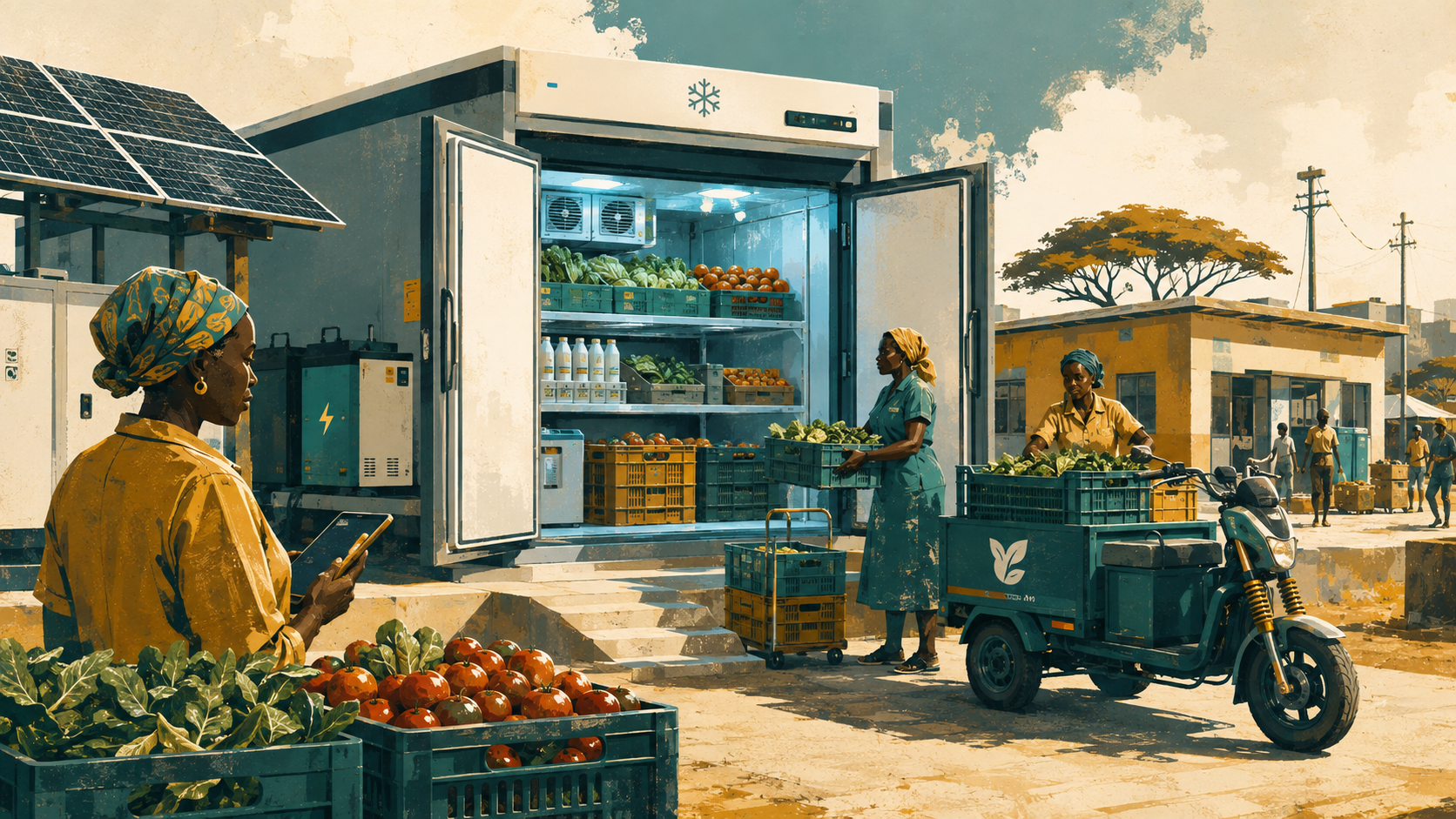
A household lighting load is valuable but often modest. A maize mill, irrigation pump, cold room, water-treatment system, clinic, school, workshop or charging hub can create larger and more regular demand. Some loads can also be scheduled into periods when household consumption is low, improving the shape of the load curve rather than simply increasing its peak.
This does not mean every mini-grid needs the same anchor customer. The right load depends on local production, incomes, public services, water availability, transport patterns and market access. A fishing community may benefit from ice and cold storage. An irrigated farming area may value pumping. A trading settlement may need refrigeration, milling, welding and digital services. A clinic may require reliable refrigeration and diagnostics. The principle is common; the productive mix is local.
STONECOMMS ANALYSIS
The access sector has historically treated electricity supply and economic development as sequential: first connect, then productive activity follows. The live programmes examined here suggest a more useful sequence for distributed systems: co-design the supply asset and the first wave of productive demand. That can change both development impact and project finance.
3 THREE LIVE TESTS OF DEMAND-FIRST ELECTRIFICATION
Ethiopia, Nigeria and Regional DARES are turning productive use into programme architecture
3.1 Ethiopia: put agriculture into the mini-grid model
In July 2026 the African Development Bank approved a US$2 million reimbursable SEFA grant for two renewable mini-grids in Ethiopia under the Distributed Renewable Energy and Agriculture Modalities programme, known as DREAM. The grant can contribute up to half of the mini-grid project capital expenditure. AfDB describes DREAM as a first-of-its-kind model that combines renewable-energy mini-grids with productive agricultural demand. [5]
The importance is not the grant size. It is the design logic. Agriculture is not being treated as an incidental beneficiary of rural electrification; it is part of the demand case. That creates the possibility of aligning irrigation, processing, storage or other farm loads with the generation asset from the beginning.
The evidence is not yet strong enough to claim that the model will be commercially superior. The projects are still being developed and the economics will depend on crop values, equipment utilisation, farmer finance, tariffs and management. But DREAM is a useful experiment because it makes the hypothesis testable.
3.2 Nigeria: scale connections and productive appliances together
Nigeria’s DARES programme is one of the continent’s largest distributed-energy initiatives. The programme targets more than 17.5 million people, more than 3.2 million household connections, 1,225 mini-grids and nearly 237,000 MSMEs receiving new or improved electricity services. Its stand-alone solar component includes Productive Use of Energy and Solar for Business sub-components. [6]
The productive-use programme is aimed at equipment such as cold rooms, agro-processing machinery, solar irrigation, telephony kiosks and battery charging or swapping. The Solar for Business component targets markets, blue-collar clusters and agro-processing businesses requiring larger systems than a basic household connection. [14]
That matters because it builds the customer’s productive equipment into the programme rather than assuming that a newly connected enterprise can finance appliances from its own balance sheet. Electricity access can be constrained by the cost of the thing that uses the electricity.
3.3 West and Central Africa: aggregate demand across countries
In June 2026 the World Bank approved US$200 million for the first phase of a broader US$853 million Regional DARES programme covering Benin, the Central African Republic, Liberia and Sierra Leone. The programme uses distributed renewables, results-based financing and regional market aggregation, and explicitly links electricity access to businesses, farms, public institutions and productive use. [7]
The regional structure is significant. Distributed-energy providers often face fragmented national markets, small procurement volumes and high transaction costs. Aggregating demand across countries may improve scale, while productive-use components can improve demand inside individual sites. One mechanism works across markets; the other works within the load curve.
4 THE CAPITAL STACK IS CHANGING
The sector is attracting more sophisticated finance - but the hardest customers remain difficult
GOGLA reports that investment in off-grid solar companies reached US$315 million in 2025, slightly above 2024. Nigeria accounted for US$114 million, the largest single-country total recorded in the dataset. The report also points to more structured finance, local-currency transactions and receivables finance, while noting that capital is increasingly concentrated among larger companies. [10]
That pattern is consistent with a maturing sector: stronger operators can access more complex capital, but smaller firms and harder geographies can struggle to attract it. The risk is that commercial finance flows toward customers who are easiest to serve while public access targets increasingly require investment in customers who are hardest to serve.
Zafiri is one response. Launched commercially in June 2026 with US$176 million, the blended permanent-capital vehicle is designed to provide patient equity to distributed renewable energy businesses, including mini-grids, solar home systems and productive-use energy. It aims to facilitate new electricity connections for more than 10 million people by 2030 and eventually scale beyond the initial capital base. [8]
This is important because equity can absorb early-stage and operating risks that conventional debt may not. But capital structure alone cannot manufacture demand. If customers lack appliances, working capital, market access or confidence that electricity will be reliable, even patient equity may finance underutilised assets.
The demand side therefore needs its own capital stack: appliance finance, leasing, working-capital products, results-based subsidies where justified, credit enhancement and public-service procurement. The electricity asset and the productive asset should be financed as parts of one local economic system, even when different institutions own them.
5 STONECOMMS ORIGINAL SYNTHESIS
The Load Activation Covenant
StoneComms proposes a simple addition to distributed-energy finance: every material public or development-finance package should state how the project intends to activate useful demand and how that demand will be measured. The covenant would not prescribe one technology or one appliance. It would require the economics of utilisation to be explicit.
1 MAP THE LOAD BEFORE FINALISING THE ASSET
The demand study should identify households, enterprises, farms and public institutions separately; estimate when they consume electricity; distinguish existing suppressed demand from new productive demand; and test whether projected users can afford the equipment required. A single annual kilowatt-hour forecast is not enough.
2 FINANCE THE APPLIANCE, NOT ONLY THE WIRE
Where pumps, refrigeration, milling, tools, water systems or charging equipment are essential to the demand case, the financing plan should show how users will acquire them. This may involve leases, pay-as-you-go structures, concessional credit, results-based incentives or procurement by public institutions. The principle is that the connection and the load should not be financed in separate universes.
3 SECURE AT LEAST ONE CREDIBLE ANCHOR WHERE THE MODEL NEEDS IT
An anchor could be a clinic, school, water system, telecom tower, processor, cold store, charging hub or business cluster. The purpose is not to make one customer indispensable. It is to create enough predictable load to reduce the risk that a new system spends its first years waiting for demand to materialise.
4 REPORT PRODUCTIVE KILOWATT-HOURS
Connection counts should remain visible, but financiers should also track electricity used by enterprises and public institutions, appliance utilisation, daytime load factor, service uptime and growth in productive demand. For projects with livelihood objectives, the monitoring plan should distinguish electricity sold from economic outcomes such as processing volumes, operating hours or reduced spoilage.
5 BUILD AN EXIT FROM SUBSIDY
Where subsidies are required to reach poor customers, the covenant should state what would allow them to decline: rising utilisation, lower technology costs, improved collection, increased productive load or refinancing. A subsidy can be an investment in market formation; it becomes a problem when no pathway to a stronger operating model is defined.
The analytical bridge
The covenant follows from four observed facts. First, Mission 300’s remaining markets are difficult and distributed energy will carry a large share of delivery. [2] Second, higher-load users materially change mini-grid consumption. [4] Third, major programmes in Ethiopia and Nigeria are already integrating productive use into project design. [5][6] Fourth, new capital vehicles are trying to improve the supply of patient finance to the sector. [8]
The new proposition is that these elements should be joined into one financing discipline. That proposition has not been validated through a cross-country causal study. It is a framework for designing and testing projects, not a claim that every productive-use intervention will improve returns.
6 A PAN-AFRICAN SCALABILITY TEST
Standardise the financing questions, not the local economy
Productive-use strategies cannot be copied mechanically across Africa. The economics of a solar pump in Ethiopia, a cold room in Sierra Leone, a welding cluster in Nigeria and a clinic in a remote Sahelian settlement are different. So are tariffs, credit markets, agricultural value chains, utility reliability and incomes.
The scalable element is therefore not the appliance. It is the diagnostic.
- Which loads can use electricity during periods when the asset is underutilised?
- Which users could become anchors without creating excessive concentration risk?
- What productive equipment is missing, and who can finance it?
- What local market or value-chain constraint could make the appliance unprofitable even if electricity is cheap?
- Which public institutions can commit predictable demand and payment?
- What data will reveal whether demand is genuinely growing after connection?
This allows different countries to pursue different technologies while retaining a common investment discipline. It also reduces the temptation to treat a successful appliance pilot as proof that the same intervention should be scaled everywhere.
The current policy environment is favourable to that approach. In July 2026 GOGLA argued that the global access debate needs to answer both who receives energy and what the energy is for; it pointed to health, livelihoods and economic opportunity as central to durable access. [11] In August, GOGLA and the International Solar Alliance renewed cooperation around off-grid solar, including market intelligence, quality standards, local manufacturing and catalytic finance. [12] The direction of travel is toward systems, not devices.
7 IMPLICATIONS FOR POLICY, CAPITAL AND IMPLEMENTATION
Five changes would make access finance more investable without weakening the social goal
1. Add load activation to National Energy Compact delivery dashboards
Mission 300’s compact architecture creates a natural place to monitor more than connections. Countries could report business and institutional connections, productive-use appliance deployment and productive kilowatt-hours alongside household access. The programme already recognises these broader outcomes; the opportunity is to make them more operationally visible. [2]
2. Pair results-based finance with demand milestones
Results-based finance often pays for verified connections or equipment delivery. Where productive-use outcomes are central, a second tranche could reward verified utilisation, service availability or productive load after a defined period. The metric must be designed carefully to avoid penalising providers for macroeconomic shocks they cannot control.
3. Treat public institutions as energy-market participants
Clinics, schools and water systems are development priorities, but they can also be anchor customers. Government and donor procurement can strengthen mini-grid demand if budgets for electricity are credible and payment systems are reliable. An unfunded public institution is not an anchor load; it is a receivable risk.
4. Build appliance finance into agriculture and SME programmes
Energy ministries should not carry the whole productive-use agenda. Agriculture, health, enterprise, water and transport programmes can finance the equipment that converts electricity into outcomes. Ethiopia’s DREAM design is important precisely because it crosses the energy-agriculture boundary. [5]
5. Publish load data that investors can underwrite
Aggregate, privacy-safe information on load profiles, payment performance, productive-use adoption and appliance utilisation would make future projects easier to price. A sector that wants more local-currency commercial finance needs evidence about customers after connection, not only engineering performance before it.
8 RISKS, COUNTERARGUMENTS AND LIMITATIONS
Demand stimulation can waste money if the local market is not ready
The strongest counterargument is that productive-use programmes can become appliance-distribution schemes that overestimate local demand. A cold room does not create a profitable cold chain if farmers cannot aggregate produce, roads are poor or buyers are absent. A solar pump does not guarantee higher incomes if water is scarce, agronomy is weak or crop prices collapse. A mill can sit idle if the catchment is too small.
The response is not to abandon productive use. It is to subject it to the same demand discipline as the electricity asset. The question is not whether an appliance has development value in theory, but whether the local economic system can use it.
A second risk is tariff distortion. High-load commercial users may be asked to cross-subsidise household access to a degree that makes self-generation more attractive, causing the anchor customer to leave the system. Tariff design should balance affordability with the need to retain the very loads that support utilisation.
A third risk is concentration. One mine, telecom tower or processor can make a mini-grid bankable, but it can also make the project fragile if that customer closes or renegotiates. A portfolio of smaller productive users may be more resilient even if it is harder to originate.
Finally, the evidence base remains uneven. Programme announcements and investment targets do not establish realised load factors, enterprise income effects or long-term subsidy requirements. The current desk evidence supports a design hypothesis, not a continent-wide estimate of financial uplift.
9 COMMISSIONABLE RESEARCH AGENDA
Build the first comparable dataset on what happens after connection
The next useful study is not another catalogue of technologies. It is a cross-country measurement programme linking electricity-system performance to productive demand and local economic outcomes.
A credible 20-week commission across four to six distributed-energy portfolios could combine:
- Smart-meter data: hourly load profiles by household, enterprise and public-institution category, with privacy safeguards.
- Appliance data: ownership, utilisation, failure rates, financing terms and seasonal use for pumps, refrigeration, milling, tools and charging.
- Enterprise evidence: operating hours, energy cost, output, spoilage, staffing, revenues and switching between grid, mini-grid and diesel or petrol.
- Public-service evidence: clinic cold-chain uptime, diagnostic availability, school operating hours, water pumping and payment performance.
- Finance data: connection subsidy, appliance subsidy, collections, arrears, cost of capital, refinancing and exposure to foreign-exchange risk.
- Market context: road access, crop markets, mobile money, input finance, customer density and competing energy sources.
The central analytical question would be simple: after controlling for site and market conditions, which combinations of productive load, appliance finance and anchor customers are associated with higher utilisation and stronger operating performance? The result could become a practical underwriting tool for governments, DFIs, mini-grid developers and impact investors.
10 CONCLUSION
Count the connection. Then count what it makes possible.
Africa’s electricity-access challenge is still fundamentally about scale. More than half a billion people in sub-Saharan Africa remain without electricity, and the pace of progress must accelerate sharply. [3] Mission 300’s first fifty million connections show that the institutional machinery can move faster. [1]
The next phase needs a second kind of scale: not only more customers, but more useful demand per system. The evidence from IEA analysis, Ethiopia’s DREAM programme, Nigeria’s DARES architecture and the new Regional DARES platform points in the same direction. Productive use is becoming part of the electrification model rather than an afterthought. [4][5][6][7]
STONECOMMS ORIGINAL SYNTHESIS
The most valuable electricity connection may be the one that changes the economics of the next connection. A pump that raises farm output, a cold room that reduces losses, a clinic that becomes a reliable anchor customer or a workshop that shifts from diesel to electricity can create development value while also improving utilisation of the energy asset around it.
That is why the next financing frontier is the kilowatt after connection.
If public and development capital starts underwriting activated demand as deliberately as it underwrites supply, Africa’s distributed-energy systems can be judged not only by how many people they reach, but by how much economic and social capacity they leave switched on.
Methodology
A desk study of electricity access as a demand-and-supply system
Research question: As Mission 300 accelerates electricity connections across Africa, what financing and delivery mechanisms could increase the economic durability of distributed-energy projects by activating productive demand?
Scope: Pan-African synthesis with current programme evidence from Mission 300, the International Energy Agency, Ethiopia’s DREAM programme, Nigeria’s DARES programme, Regional DARES in West and Central Africa, Zafiri and the off-grid solar industry. Evidence was reviewed through 30 August 2026.
Unit of analysis: Distributed electricity systems and the demand created by households, enterprises, farms and public institutions, rather than national generation capacity or grid reform as a whole.
Evidence base: Primary and institutional sources were prioritised: World Bank Group, African Development Bank Group, IEA, Nigeria Rural Electrification Agency, GOGLA and related official programme material. Company and industry data are attributed to the issuing body and are not treated as independently audited unless the source states otherwise.
Method: Qualitative cross-source synthesis and descriptive comparison. StoneComms tested whether current access-finance evidence supports a common proposition: that productive demand can be designed alongside supply and may improve both development outcomes and system utilisation. No causal inference is made from programme announcements.
Original synthesis: The concepts of activated load and the Load Activation Covenant are StoneComms frameworks derived from the cited evidence. They have not been empirically validated as a standard or financial instrument.
Limitations
- No fieldwork, firm interviews, household survey, smart-meter dataset or proprietary project financial model was used.
- Programme targets, connection counts and investment figures are reported by the issuing institutions and may use different definitions or verification methodologies.
- The IEA evidence on mini-grid consumption is sector-level and does not imply that every business or public institution will improve a project’s economics.
- Productive-use equipment can fail to deliver value when constraints such as market access, water, roads, skills, maintenance or working capital are binding.
- The Load Activation Covenant is an analytical proposal, not a tested financing standard. Its effect on default, utilisation, tariffs and subsidy requirements requires empirical testing.
- Country-level regulatory, tariff, consumer-protection and procurement rules differ materially and must be assessed locally before implementation.
Sources
Public-source desk research completed on 30 August 2026. Primary and institutional sources were prioritised. Programme, market and investment figures are attributed to the issuing organisations. StoneComms did not conduct fieldwork or access proprietary meter, enterprise or project-finance data. The activated-load and Load Activation Covenant frameworks are StoneComms original synthesis from the cited evidence.
- World Bank Group. Under Mission 300, A New Way of Doing Business Connects Over 50 Million People to Electricity Across Africa. 16 June 2026. https://www.worldbank.org/en/news/press-release/2026/06/16/under-mission-300-a-new-way-of-doing-business-connects-over-50-million-people-to-electricity-across-africa
- World Bank Group. Mission 300 FAQ on Bringing Electricity to 300 Million in Africa. accessed 30 August 2026. https://www.worldbank.org/ext/en/energizingafrica/faq
- World Bank / IEA / IRENA / WHO / UN Statistics Division. 655 Million People Still Without Electricity Underscore Urgent Need to Deliver Universal Energy Access. 24 June 2026. https://www.worldbank.org/en/news/press-release/2026/06/16/accelerating-universal-energy-access
- International Energy Agency. Financing Electricity Access in Africa. 2025. https://www.iea.org/reports/financing-electricity-access-in-africa
- African Development Bank Group. Ethiopia: Sustainable Energy Fund for Africa to extend $2 million for pioneering energy-agriculture mini-grid project. 29 July 2026. https://www.afdb.org/en/news-and-events/ethiopia-sustainable-energy-fund-africa-extend-2-million-pioneering-energy-agriculture-mini-grid-project-95847
- Nigeria Rural Electrification Agency. Distributed Access through Renewable Energy Scale-up (DARES). accessed 30 August 2026. https://www.dares.rea.gov.ng/
- World Bank Group. World Bank Supports Regional Program to Expand Renewable Energy Access and Create Jobs in West and Central Africa. 22 June 2026. https://www.worldbank.org/en/news/press-release/2026/06/22/world-bank-supports-regional-program-to-expand-renewable-energy-access-and-create-jobs-in-west-and-central-africa
- African Development Bank Group / IFC. Zafiri announces USD 176 million commercial launch to accelerate energy access via the private sector across sub-Saharan Africa. 17 June 2026. https://www.afdb.org/en/news-and-events/press-releases/zafiri-announces-usd-176-million-commercial-launch-accelerate-energy-access-private-sector-across-sub-saharan-africa-94563
- GOGLA. Record Sales Highlight Off-Grid Solar’s Critical Role in Electrification. 3 June 2026. https://newsroom.gogla.org/266354-record-sales-highlight-off-grid-solar-s-critical-role-in-electrification/
- GOGLA. Off-grid solar investment signals sector maturation, capital concentration. 15 June 2026. https://newsroom.gogla.org/267019-off-grid-solar-investment-signals-sector-maturation-capital-concentration/
- GOGLA. Energy for Who? Energy for What?. 16 July 2026. https://gogla.org/blog/energy-for-who-energy-for-what/
- GOGLA / International Solar Alliance. GOGLA and the International Solar Alliance Renew and Expand Global Cooperation on Off-Grid Solar. 26 August 2026. https://newsroom.gogla.org/269657-gogla-and-the-international-solar-alliance-renew-and-expand-global-cooperation-on-off-grid-solar/
- World Bank Group. Don’t Let a Crisis Go to Waste: Pivoting Africa’s Transport to Clean Energy. 29 June 2026. https://www.worldbank.org/en/news/feature/2026/06/29/dont-let-a-crisis-go-to-waste-pivoting-africa-s-transport-to-clean-energy
- Nigeria Rural Electrification Agency. Official Launch: Solar for Business and Productive Use of Energy Sub-Components. 18 December 2025. https://nep.rea.gov.ng/posts/SBF-and-PUE-Launch.html