Key metrics
- US$144.4m - approximate local-currency lending expected to be catalysed by IFC's first African Catalytic First Loss Guarantee transactions. [1]
- ~11:1 - IFC target leverage: financing supported per dollar of first-loss capital in the Kenya transactions. [1]
- 52.3% vs 64.4% - women vs men with an account in sub-Saharan Africa in 2024; a 12.1-point gap. [2]
- US$1.5bn+ - AFAWA-reported financing disbursed to more than 26,000 women-led SMEs through partner institutions across 44 countries. [3]
- 47% - share of Gargaara-supported loans in Somalia reported to have benefited women-owned MSMEs. [6]
EXECUTIVE THESIS
Africa's women-owned and women-led businesses are entering a more sophisticated financing era. On 4 August 2026, IFC announced its first African transactions under the Catalytic First Loss Guarantee programme, using blended first-loss capital to support lending through 4G Capital, Equity Bank Kenya and KCB Bank Kenya. Across the three transactions, IFC committed US$24.2 million, backed by US$11 million from the IDA Private Sector Window, with the package expected to catalyse about US$144.4 million of local-currency lending to microenterprises, women-owned businesses and climate-focused enterprises. IFC's target leverage is approximately eleven dollars of financing for each dollar of first-loss capital. [1]
That is exactly the kind of financial engineering Africa's small-business market needs. It changes the lender's risk equation. But it does not, by itself, change whether a woman entrepreneur has recognised identification, a registered enterprise, a usable transaction history, collateral or a credible substitute for it, a product designed for her cash-flow pattern, or access to a market large enough to justify borrowing.
The evidence now emerging from several African markets suggests that this distinction is becoming the next frontier. The World Bank's latest gender data show that in 2024 only 52.3 per cent of women in sub-Saharan Africa had an account, compared with 64.4 per cent of men - a 12.1 percentage-point gap. [2] At the same time, the African Development Bank's AFAWA platform reports more than US$1.5 billion disbursed to over 26,000 women-led SMEs through roughly 200 partner financial institutions across 44 African countries. [3] Scale is growing; structural exclusion has not disappeared.
This week, UNECA completed technical work in Sierra Leone and The Gambia that makes the problem unusually visible. Its Sierra Leone programme describes women entrepreneurs as constrained simultaneously by income insecurity, weak collateral ownership, low financial and digital literacy, care responsibilities, standardised financial products, limited use of sex-disaggregated data, infrastructure gaps and fragmented coordination. [4] In The Gambia, UNECA reports that only around 15 per cent of women access formal financial services, compared with 23 per cent of men, and explicitly links the implementation gap to weak coordination, weak data and the failure to embed women's financial inclusion into mainstream planning and budgeting. [5]
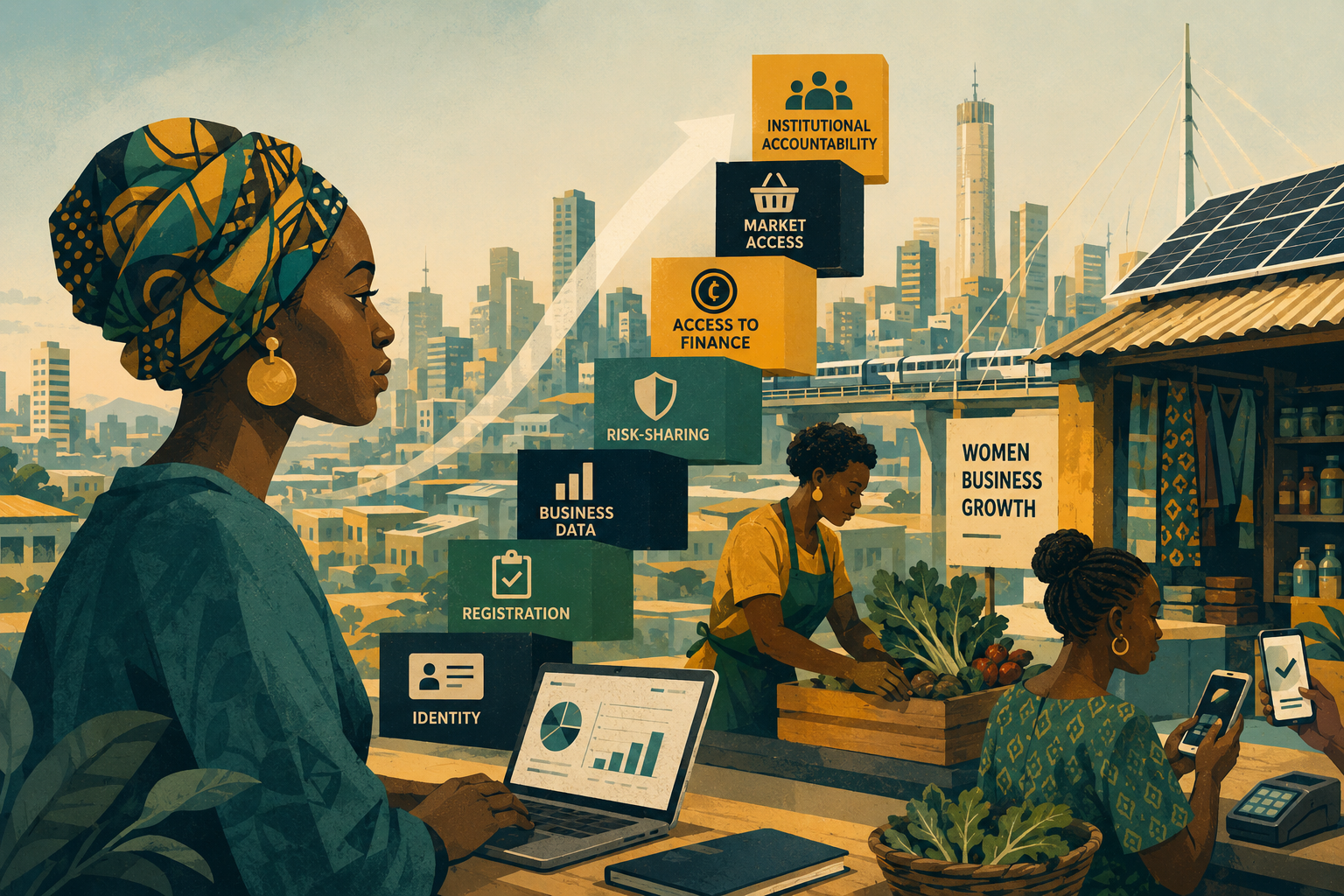
STONECOMMS ORIGINAL SYNTHESIS: The next unit of gender-lens finance should be the financeability stack - the set of conditions that allows capital to recognise, price, reach and grow a business. Guarantees and credit lines are one layer. Identity, registration, business data, collateral alternatives, product design, market access and institutional accountability are the others. A financing programme that funds only the loan can still leave the pipeline starved.
KEY FINDINGS
01 RISK-SHARING CAN MULTIPLY CAPITAL, BUT IT ONLY SOLVES ONE PART OF THE LENDING DECISION. IFC's Kenya transactions show the leverage available when public first-loss capital changes a lender's downside. [1] The remaining question is whether enough women-owned firms can enter the eligible portfolio with records lenders can underwrite.
02 THE GENDER GAP IS NOT SIMPLY A CREDIT GAP. World Bank data show a 12.1 percentage-point gap in account ownership in sub-Saharan Africa. [2] UNECA's current country work points to identification, collateral, data, literacy, care, infrastructure and coordination as interacting constraints. [4][5]
03 AFRICA ALREADY HAS LARGE-SCALE GENDER-FINANCE PLATFORMS. AFAWA reports more than US$1.5 billion disbursed to over 26,000 women-led SMEs, while its guarantee architecture can provide substantial loss coverage to partner financial institutions. [3][7] The question is how to increase conversion from eligible woman-owned business to investable borrower.
04 FOUNDATIONAL DIGITAL AND FORMALISATION INFRASTRUCTURE CAN CHANGE THE PIPELINE. In Somalia, World Bank-supported programmes combine wholesale finance, digital ID, business registration and risk-sharing; 47 per cent of loans under the Gargaara programme have benefited women-owned MSMEs, while women's share of national ID registrations increased from 21 per cent to 31 per cent between 2024 and 2025. [6]
05 MARKET ACCESS BELONGS INSIDE THE FINANCE MODEL. HerAfCFTA and other current initiatives are shifting attention from formal commitments to practical conditions that let women participate in the single market. [8] A loan is easier to repay when the borrower can reach procurement, trade and value-chain opportunities.
06 THE NEXT KPI SHOULD BE A CONVERSION FUNNEL, NOT JUST A DISBURSEMENT TOTAL. StoneComms proposes tracking how many target firms are identifiable, registered, data-visible, assessed, offered finance, financed, retained, repaying and growing. That reveals where exclusion migrates when one constraint is removed.
1 WHY THIS MATTERS NOW
The women-business finance debate is often framed around a large continental financing gap. The precise estimate varies across African Development Bank materials, but the direction is not disputed: women-owned and women-led enterprises remain materially underfunded. [3][7] The practical danger is that the size of the gap becomes the analysis. It tells policymakers how much capital is missing, but not where the financing system loses otherwise viable firms.
The newest transactions make that second question more urgent. IFC's Kenya package is not a generic credit line. It uses first-loss protection to change portfolio economics for lenders serving microenterprises and underserved businesses. That is important because perceived or actual credit risk can prevent banks and non-bank lenders from expanding into segments where conventional security is weak. [1]
AFAWA has pursued a related logic at continental scale. Its access-to-finance pillar combines African Development Bank investment instruments with a guarantee mechanism intended to de-risk women's portfolios, while technical assistance helps financial institutions design products and non-financial services for women entrepreneurs. [7] In Nigeria, the African Development Bank approved a US$61 million package in 2026 combining a gender-focused line of credit, concessional finance and a grant linked to AFAWA and We-Fi. [10] In Namibia, a dedicated facility ring-fences finance for 100 per cent women-owned enterprises. [9]
These are signs of maturation. The sector is moving beyond 'lend more to women' toward instruments that alter risk, tenor, product design and lender capability. The next step is to connect those instruments to the infrastructure that determines whether a business can be seen and assessed in the first place.
2 THE LOAN STARTS BEFORE THE LOAN
A financial institution cannot underwrite what it cannot reliably identify. It cannot price a business it cannot distinguish from household cash flow. It cannot rely on collateral a borrower does not legally or practically control. It cannot build a gender-smart product if it does not collect sex-disaggregated portfolio data. And it cannot infer growth potential from a static application form when the business trades through digital payments, informal supplier credit and seasonal inventory cycles that the bank never sees.
This is why the latest country programmes matter. UNECA's Sierra Leone work does not describe one bottleneck; it describes an interacting system. Women entrepreneurs face demand-side constraints, supply-side constraints and enabling-environment constraints at the same time. The country's roughly 1.5 million women operating in micro- and small-business activities are concentrated in sectors such as petty trade, small-scale agriculture, food processing and personal services, where informality and weak collateral can make conventional banking models especially blunt. [4]
The Gambia presents a similar coordination problem. UNECA's current programme is not simply a financial-literacy project. It is developing technical guidelines, planning checklists, gender-responsive budget tagging, scheme-design templates, indicator menus and institutional coordination mechanisms. [5] That is significant because it treats financial inclusion as a public-management system rather than a stand-alone banking initiative.
STONECOMMS ANALYSIS: Once risk-sharing capital becomes available, exclusion can migrate upstream. The lender is more willing to take risk, but the target firm may still fail eligibility, documentation or underwriting. The policy response therefore has to ask where the funnel narrows after de-risking, not assume that de-risking automatically fills the pipeline.
3 SOMALIA SHOWS WHAT FOUNDATIONAL FINANCIAL INFRASTRUCTURE LOOKS LIKE
Somalia is useful precisely because its financial system has had to build several foundations at once. The World Bank reports that women own more than half of household businesses, yet many remain constrained by weak access to finance, formal registration and identification. [6]
The response has combined wholesale credit, institutional reform, business registration and digital identity. The Gargaara wholesale financing facility has provided lines of credit to 12 financial institutions with a target of at least 40 per cent of loans to women-owned MSMEs; the World Bank reports that 47 per cent of loans under the programme have benefited women-owned MSMEs. [6]
At the same time, digital identification and online business registration are being expanded because those services affect access to finance and government systems. Women's share of national ID registrations rose from 21 per cent to 31 per cent between 2024 and 2025. Future programmes aim to extend digital ID to an additional 2.5 million women and register more women-owned MSMEs, alongside guarantees and business-development services. [6]
The lesson is not that Somalia's model should be copied. Its institutional context is distinctive. The lesson is architectural: credit, ID, registration, regulation and risk-sharing are being treated as connected parts of one enterprise-finance system. That is the logic other markets can adopt even when the specific institutions are different.
4 THE FINANCEABILITY STACK
STONECOMMS ORIGINAL SYNTHESIS
StoneComms proposes a six-layer Financeability Stack for public and development-finance programmes targeting women-owned and women-led businesses. It is not a new certification and should not become another administrative burden. It is a diagnostic for locating the constraint that prevents capital from converting into productive business finance.
4.1 PROVE - identity and enterprise recognition
The first layer is the ability to prove who the entrepreneur is and what the business is. That can involve national ID, business registration, tax or municipal records, beneficial ownership and basic permissions. The objective is not formalisation for its own sake. It is to reduce the cost and ambiguity of entering a financial relationship.
Digital systems can help, but they can also exclude if registration requires devices, connectivity, literacy or travel that are unevenly distributed. Programmes should therefore measure not only whether a digital service exists, but whether target women can actually complete it.
4.2 SEE - usable, sex-disaggregated and cash-flow data
A lender that cannot see the economics of women-owned firms will fall back on proxies, generic products and collateral. AFAWA has explicitly highlighted the gender data gap as a barrier to designing effective products and policies. [12]
The useful data are not only demographic. They include sales flows, inventory cycles, payment histories, seasonality, customer concentration, digital receipts and repayment performance. Where privacy and consent permit, these can support cash-flow underwriting and reveal businesses that conventional collateral tests misclassify as unbankable.
4.3 SHARE - allocate risk to the institution best able to absorb it
This is the layer where first-loss guarantees, partial credit guarantees, concessional tranches and portfolio risk-sharing sit. IFC's Kenya structure shows the potential leverage. AFAWA's guarantee architecture likewise aims to increase lender appetite by covering a material share of losses. [1][7]
The discipline is to use subsidy where market failure is identified, not where it merely makes a portfolio easier. Guarantee design should be transparent about additionality, target segment, loss allocation, pricing, duration and what should happen when lenders build sufficient information to price the segment commercially.
4.4 FIT - design the product around the business, not the stereotype
Women entrepreneurs are not one risk class. A wholesaler, processor, technology founder, trader, farmer and transport operator have different working-capital cycles, asset bases and growth paths. Standardised products can turn those differences into rejections.
Product fit includes loan size, tenor, repayment frequency, grace period, collateral alternatives, digital versus branch servicing, and whether a lender can finance inventory, equipment or invoices rather than offer only short-term consumption-style credit. Technical assistance to financial institutions matters because product design is an institutional capability, not a brochure. [7]
4.5 CONNECT - market access is part of creditworthiness
A business can be financeable on paper and still lack a market large enough to support growth. The current HerAfCFTA agenda is therefore relevant to finance. It is explicitly focused on practical solutions that allow women entrepreneurs to participate in Africa's single market and economic transformation. [8]
The financing implication is straightforward. Procurement programmes, supplier-development platforms, export support, standards assistance, logistics, digital commerce and trade finance can strengthen the revenue side of a borrower's balance sheet. A lender is not only financing an entrepreneur; it is financing a position in a market.
4.6 EMBED - put inclusion into budgets, regulation and accountability
The final layer is institutional durability. Pilot programmes are easy to launch and hard to mainstream. UNECA's work in The Gambia and Sierra Leone is important because it connects financial inclusion to planning, budgeting, regulation, indicator design and coordination. [4][5]
Gender-responsive budget tagging is particularly useful when it is connected to outcomes rather than activity labels. A government should be able to see not only how much it spent on a women-enterprise programme, but where the financeability funnel improved: registration, underwriting, approval, use, repayment, growth or market access.
5 A PAN-AFRICAN SCALABILITY TEST
The Financeability Stack is designed to travel because it standardises the questions, not the answers. The 12.1-point account-ownership gap in sub-Saharan Africa is a regional aggregate; it does not mean every country has the same barrier or that every woman entrepreneur needs the same intervention. [2]
In Kenya, mature banks and fintech lenders make risk-sharing and portfolio expansion central. [1] In Somalia, ID, business registration and wholesale financial infrastructure remain foundational. [6] In Sierra Leone and The Gambia, UNECA is emphasising coordination, data and policy implementation. [4][5] Namibia and Nigeria are using dedicated credit and blended-finance structures through development banks. [9][10]
The scalable discipline is therefore diagnostic sequencing: identify the narrowest layer, finance it, measure the next constraint that appears, and avoid forcing every country into the same 'women's finance product'.
6 IMPLICATIONS FOR POLICY, CAPITAL AND IMPLEMENTATION
1. ADD A FINANCEABILITY COVENANT TO GENDER-LENS FACILITIES. Large public or DFI-backed facilities should specify which upstream constraints they are financing alongside the credit instrument - ID, registration, data, product redesign, collateral alternatives, market access or institutional coordination - and how those changes will be measured.
2. PUBLISH THE CONVERSION FUNNEL. Report eligible target firms, identifiable firms, registered firms, completed applications, approved applications, disbursements, repeat borrowing, repayment, revenue or employment growth where measurable. A single disbursement total hides where exclusion still occurs.
3. TREAT SEX-DISAGGREGATED PORTFOLIO DATA AS FINANCIAL INFRASTRUCTURE. Banks and regulators need consistent definitions of women-owned and women-led firms, portfolio performance by segment, product usage and rejection reasons. Data should be privacy-safe and designed for decision-making rather than reporting theatre. [12]
4. LINK GUARANTEE PRICING TO EVIDENCE. First-loss and guarantee support should create a learning pathway toward better commercial underwriting. If a lender's portfolio demonstrates strong repayment and low loss, the public risk share should be capable of declining or moving to a harder segment.
5. FINANCE MARKET ACCESS. Procurement readiness, trade documentation, standards compliance, digital commerce and value-chain connections should be eligible components where weak market access is the binding constraint. HerAfCFTA gives this agenda a continental route. [8]
6. MAKE BUDGET TAGGING OPERATIONAL. Gender-responsive budget tags should connect spending to the financeability funnel so ministries can see which constraints are actually shifting. UNECA's current work creates a practical basis for testing this approach. [4][5]
7 RISKS, COUNTERARGUMENTS AND LIMITATIONS
The strongest counterargument is that adding layers to gender-lens finance could create bureaucracy. A business that needs working capital should not be forced through six new programmes before receiving a loan. That would turn a diagnostic into a gatekeeping device.
The response is sequencing. The stack is not a checklist every entrepreneur must complete. It is a way for programme designers to identify which constraint is binding for which segment. A digitally registered urban retailer may need only product fit and working capital. A rural informal processor may face ID, registration, logistics and collateral constraints simultaneously.
A second risk is over-formalisation. Registration can improve access to finance and markets, but it can also expose a microenterprise to costs, taxes or compliance obligations before the benefits are real. Formalisation policy should therefore be tied to service value: easier finance, procurement access, social protection, digital payments or business support.
A third risk is data misuse. Alternative data and sex-disaggregated analytics can improve underwriting, but they can also create opaque scoring systems or intrusive surveillance. Consent, explainability, data minimisation and the ability to contest decisions should be part of any data-enabled finance model.
A fourth risk is moral hazard in guarantee programmes. A lender may loosen underwriting because public capital absorbs losses, or use a guarantee for customers it would have financed anyway. Additionality tests, portfolio audits and transparent loss-sharing are therefore essential.
Finally, gender-targeted finance can become performative if it measures only money routed through labelled programmes. The relevant outcome is whether women-owned and women-led firms gain durable access to finance on terms that support productive growth.
8 COMMISSIONABLE RESEARCH AGENDA
The next useful StoneComms study would measure the financeability funnel across four to six African markets using transaction-level evidence rather than programme announcements.
A credible 20-week commission could combine lender portfolio data, application and rejection records, entrepreneur interviews, digital-ID and business-registration data, collateral and guarantee usage, product terms, procurement or trade access, and enterprise outcomes. The study should compare women-owned/led firms with relevant control groups while preserving privacy and recognising sector and country differences.
The core analytical question would be: at which stage do viable women-owned firms leave the financing pipeline, and which intervention moves the greatest number of them into sustainable commercial finance at the lowest public cost?
Outputs could include a country-by-country Financeability Funnel, a lender diagnostic, guarantee additionality tests, product-design recommendations, a gender-data protocol, and a policy roadmap linking financial inclusion to budgeting and market access. The most credible client group would be a consortium of DFIs, central banks, finance ministries, financial institutions and women's enterprise networks that need a shared evidence base but retain different mandates.
9 CONCLUSION
Africa does not lack women who run businesses. It lacks a financial system that can consistently recognise, assess and finance the full range of those businesses at scale.
The next phase is already visible. IFC is using first-loss capital to multiply lending in Kenya. AFAWA has built a continent-wide platform combining finance, guarantees, technical assistance and policy engagement. Development banks in Nigeria and Namibia are creating dedicated facilities. Somalia is linking wholesale finance to digital ID and registration. UNECA is connecting women's financial inclusion to budgeting, indicators and institutional coordination in Sierra Leone and The Gambia. [1][3][4][5][6][9][10]
STONECOMMS ORIGINAL SYNTHESIS: These are not separate interventions. They are layers of financeability. The strategic opportunity is to design them as one conversion system: prove the business, see its economics, share the risk, fit the product, connect the market and embed the rules.
The loan is still important. But the balance sheet begins before the loan application. If African governments, banks and development financiers start investing in that missing balance sheet as deliberately as they invest in credit, the women-business finance gap can be attacked not only with more money, but with a better machine for making viable firms investable.
Methodology
A desk study of women-business finance as a conversion system
Research question: As African development-finance institutions and lenders deploy more sophisticated gender-lens credit and guarantee instruments, which upstream conditions determine whether women-owned and women-led firms can actually convert those facilities into sustainable business finance?
Scope: Pan-African synthesis using current evidence available to 30 August 2026, with live examples from Kenya, Sierra Leone, The Gambia, Somalia, Namibia and Nigeria, and continental evidence from the World Bank, African Development Bank/AFAWA, UNECA, IFC and UNDP/AfCFTA.
Unit of analysis: The enterprise-finance conversion pathway from identity and registration through data visibility, underwriting, risk-sharing, product fit, market access and institutional embedding.
Method: Qualitative cross-source synthesis and descriptive comparison. Primary and institutional sources were prioritised. Programme figures are attributed to the issuing institution. No causal inference is made from programme announcements, disbursement totals or case examples.
Original synthesis: The Financeability Stack, Financeability Covenant and conversion-funnel framework are StoneComms analytical proposals derived from the cited evidence. They have not been validated as formal financial standards.
Limitations
- No fieldwork, lender interviews, entrepreneur survey, proprietary credit bureau data or loan-level portfolio dataset was used.
- Published estimates of Africa's women-business financing gap vary across institutional materials and are not used here as a calculation input.
- Account ownership does not measure access to productive business credit, and regional averages conceal substantial country differences.
- Programme disbursement and leverage targets do not establish additionality, repayment performance, profitability or long-run subsidy requirements.
- The examples span different institutional environments; no claim is made that one country's mechanism should be copied mechanically elsewhere.
- Digital ID, alternative data and formalisation can create privacy, exclusion or compliance risks if implementation is poorly designed.
- The Financeability Stack is an analytical framework, not a tested underwriting model or regulatory standard.
Sources
Public-source desk research completed on 30 August 2026. Primary and institutional sources were prioritised. Programme and portfolio figures are attributed to the issuing organisations. StoneComms did not conduct fieldwork or access proprietary borrower, lender or credit-bureau data. The Financeability Stack and Financeability Covenant are StoneComms original synthesis from the cited evidence.
- IFC. IFC Supports Expansion of Financing for Kenya's Small Businesses through the First Catalytic First Loss Guarantee Transactions in Africa. 4 August 2026. https://www.ifc.org/en/pressroom/2026/ifc-supports-expansion-of-financing-for-kenya-s-small-businesses-through-the-first
- World Bank Gender Data Portal. Sub-Saharan Africa - account ownership by sex. accessed 30 August 2026. https://genderdata.worldbank.org/en/regions/sub-saharan-africa
- African Development Bank / AFAWA. 2026 AFAWA Bank of the Year Award nominees announced. 27 May 2026. https://am.afdb.org/en/news/2026-annual-meetings-2026-afawa-bank-year-award-nominees-announced
- UNECA. Technical Workshop on Women's Financial Inclusion and Gender-Responsive Budgeting - Sierra Leone. 17-21 August 2026. https://www.uneca.org/eca-events/mission-womens-financial-inclusion_17-21aug
- UNECA. Technical Workshop on Women's Financial Inclusion and Gender-Responsive Budgeting - The Gambia. 24-28 August 2026. https://www.uneca.org/eca-events/mission-womens-financial-inclusion_14-28aug
- World Bank. How Stronger Financial and Digital Services are Supporting Women's MSMEs and Jobs in Somalia. 31 March 2026. https://www.worldbank.org/en/news/feature/2026/03/31/how-stronger-financial-and-digital-services-are-supporting-women-s-msmes-and-jobs-in-somalia
- AFAWA. Access to Finance. accessed 30 August 2026. https://afawa.afdb.org/pillars/access-to-finance
- UNDP / AfCFTA Secretariat. #HerAfCFTA Regional Conference to Advance Women's Economic Leadership. 29 June 2026. https://www.undp.org/africa/press-releases/undp-afcfta-secretariat-and-federal-ministry-industry-trade-and-investment-convene-high-level-herafcfta-regional-conference
- African Development Bank. Credit Facility to Unlock Economic Power for 100% Women-Owned Enterprises in Namibia. 8 April 2026. https://www.afdb.org/en/news-and-events/press-releases/african-development-bank-funded-credit-facility-unlock-economic-power-100-women-owned-enterprises-namibia-92096
- African Development Bank. African Development Bank approves $61 million package to boost women-led businesses in Nigeria. 8 May 2026. https://www.afdb.org/en/news-and-events/press-releases/african-development-bank-approves-61-million-package-boost-women-led-businesses-nigeria-93036
- World Bank. A Winning Bet on Women's and Youth Entrepreneurship in Djibouti. 19 June 2026. https://www.worldbank.org/en/results/2026/06/19/a-winning-bet-on-women-s-and-youth-entrepreneurship-in-djibouti
- AFAWA. Bridging the gender data gap: empowering women entrepreneurs in Africa. 28 May 2025. https://afawa.afdb.org/press/bridging-gender-data-gap-empowering-women-entrepreneurs-africa